

Getting Started
Getting started with Embark is easy. Just follow these steps:
- Read this Plan Disclosure Booklet in its entirety and save it for future reference. It contains important information you should review before opening an Account, including information about the benefits and risks of investing.
-
Gather your information:
- Your Social Security number and date of birth
- Your permanent address
- Your Beneficiary's Social Security number and date of birth
- Your email address
- Your checking or savings account number and your bank's routing number (if you want to contribute electronically with a bank transfer).
- Go online to www.EmbarkSavings.com and click on Open an Account. The easy-to-follow directions will guide you through the enrollment process. Enrolling online is fast, convenient, and secure. In as little as 15 minutes, you can be fully signed up and saving for college. Or, if you prefer, you can complete and mail the Enrollment Form that is downloadable from the forms section of the website at www.EmbarkSavings.com/forms.
Summary
This Plan Disclosure Booklet provides you with important information that can help you decide whether to open an Embark Account. You can find the key terms used throughout this Plan Disclosure Booklet in the Glossary. This Summary provides highlights of the features of Embark and tells you where you can find more information about each topic.
About Embark
Upward Oregon was created by statute found at sections 178.300 to 178.355 of the Oregon Revised Statutes, as amended (the "Statute"). Upward Oregon was founded to empower all Oregonians to build lifetime financial security through accessible and professionally-managed savings programs. The Plan is administered as part of Upward Oregon by the Board, as trustee of the Oregon 529 Savings Network Trust (the "Trust"). Upward Oregon is intended to meet the requirements of a qualified tuition program under Internal Revenue Code ("IRC") Section 529 ("Section 529").
Embark is one of two Qualified Tuition Programs administered and distributed by the Board. Embark is designed to help individuals and families throughout the U.S. save for college in a tax-advantaged way, and offers valuable advantages including tax-deferred growth, generous contribution limits, attractive Investment Options, and professional investment management. Oregon also offers the advisor-sold MFS 529 Savings Plan, which is not offered under this Plan Disclosure.
Learn more at www.UpwardOregon.com
What's Inside
My Account
Embark is open to U.S. citizens or resident aliens throughout the U.S. You, as the Account Owner, maintain control over the Account and can open Accounts for any number of Beneficiaries, including yourself. This section will guide you through the details of opening an Embark Account, contributing to your Account, maintaining your Account, using your savings to pay for Qualified Expenses, and closing your Account. To open an Embark Account, you must complete your Enrollment online or send us a completed Enrollment Form, which is a contract between you, as the Account Owner, and the Board, establishing the obligations of each.
Fees
Embark has no commissions, loads, or sales charges. The Total Annual Asset-Based Fee based on historic expenses varies from 0.20% to 0.65%, depending upon the Portfolio(s) you choose and is subject to change. We also charge certain transaction- based fees that may apply to your Account. In this section, you can find a detailed description of the Fees associated with your Embark Account.
Important Risks You Should Know About
As with any investment, there are risks involved in investing in Embark, including the risk of investment losses; the risk of changes in federal and state laws, including federal and state tax laws; the risk of Program changes, including changes in Fees; and the risk that contributions to Embark may adversely affect the eligibility of you or your Beneficiary for financial aid or other benefits.
To learn more about the risks, please thoroughly read and carefully consider the information in this section and throughout this Plan Disclosure Booklet, and ask your tax, legal and investment advisors about these risks.
Investment Choices
When you enroll in Embark, you choose to invest using at least one of two different investment approaches, based upon your investing preferences and risk tolerance. You can choose between the College Enrollment Year Investment Option or the Static Investment Option, or a mix of both.
College Enrollment Year Investment Option
This option offers Portfolios designed for different Enrollment Years (anticipated year of enrollment at college) in one-year increments. In each Portfolio, your money is moved automatically to progressively more conservative investments as your Beneficiary approaches the targeted year of enrollment. Each Portfolio invests in one or more Underlying Fund(s) managed by Vanguard.
Static Investment Option
This option offers fourteen (14) Portfolios. Unlike the Portfolios in the College Enrollment Year Investment Option, if you invest in a Static Portfolio, the composition of investments within the Portfolio remains fixed over time, subject to periodic re-balancing back to the Portfolio guidelines and any changes in investment policy made by the Board. Each Portfolio invests in one or more Underlying Fund(s), each of which is managed by either Champlain, Dimensional Funds, DoubleLine, Dodge & Cox, LSV, Nuveen, T. Rowe Price, or Vanguard. If you invest in a Static Portfolio, your assets will not shift to more conservative investments over time unless you specifically direct us to move your assets to another Portfolio. The Static Investment Option also includes a FDIC-Insured cash option invested in a bank deposit with Bank of New York Mellon, subject to any changes in investment policy made by the Board.
You may change your Investment Options for balances currently in your Embark Account up to two times per calendar year, or if you change your Beneficiary. You can apply new contributions to your existing Portfolio selections, or to new Portfolios without limitation. This section also provides details on how to view investment performance of each Portfolio.
Important Federal Tax Information
As a 529 Plan, Embark offers federal tax benefits, including tax-deferred earnings. Any earnings withdrawn from your Account are free of federal income tax when applied toward Qualified Expenses. If you take a Non-Qualified Distribution, any earnings are subject to federal and applicable state income taxes and an additional 10% federal tax penalty (Distribution Tax). If you take an "Other Distribution", any earnings may be subject to federal and applicable state income taxes, but not the Distribution Tax.
Learn more about tax considerations associated with investing in Embark by thoroughly reviewing this section. Before you invest, you should consult an independent tax advisor regarding the application of tax laws to your particular circumstances.
Important State of Oregon Tax Information
Oregon taxpayers are eligible to receive state income tax credit up to $380 for joint filers and $190 for single filers. The tax credit provides the same maximum credit to all Oregonians who are saving for college, trade school or any post-secondary education through Embark. Oregon taxpayers can make contributions up until April 15 of the following year and have those contributions count for the previous year's state income tax credit. For more information visit www.oregon.gov/dor/programs/individuals/pages/credits.aspx
Learn more about state tax considerations associated with investing in Embark by thoroughly reviewing this section. Before you invest, you should consult an independent tax advisor regarding the application of tax laws to your particular circumstances.
General Information
In this section you will learn about the rights and obligations associated with your Account, considerations related to changes to your Account, this document, and state and federal laws, and claims against your Account.
Plan Administration
This section summarizes the administration of Embark.
- The Board administers and provides oversight of Embark and the MFS 529 Savings Plan.
- Vestwell Government Savings has overall responsibility for Embark's day-to-day operations, including recordkeeping, customer service, and administrative services.
- Sellwood Investment Partners provides investment advisory services to the Board for Embark.
Glossary
This section provides definitions of terms contained in this Plan Disclosure Booklet that are not otherwise defined in the Booklet. Note that terms defined in the glossary (other than you and your) appear with initial capital letters when referenced in this document.
Participation Agreement
In this section, we ask you to review and acknowledge your rights and responsibilities in connection with your enrollment in Embark. You must review this agreement in detail prior to completing an Enrollment in the Program. Upon enrolling in the Program, you will be prompted to acknowledge your understanding of, and agreement with the terms, conditions and information contained in the Plan Disclosure Booklet and the Agreement.
My Account
Account Owner/Custodian
To participate in Embark, you must complete the online Enrollment process or the Enrollment Form and open an Account either online or by mail. You must be a U.S. citizen (or a resident alien), or an entity that is organized in the U.S., be 18 years or older, and have a valid permanent U.S. residential address. You may also open an Account as a custodian for a child under the Uniform Gift to Minors Act / Uniform Transfer to Minors Act (UGMA/UTMA). By signing the Enrollment Form or completing your online Enrollment, as applicable, you consent and agree that your Account is subject to the terms and conditions of this Plan Disclosure Booklet.
Successor Owner
You may designate a Successor Owner (to the extent permissible under applicable law) to succeed all of your rights, title, and interest in your Account upon your death. You can make this designation online during Enrollment, on the Enrollment Form, or in the online saver portal. We must receive and process your request before the Successor Owner designation can be effective. You may revoke or change the designation of a Successor Owner at any time online or by submitting a Manage Successor Owner Form.
You can access forms at www.embarksavings.com/forms
Beneficiary
You can set up an Account for the benefit of your child, grandchild, spouse, yourself, another relative, or even someone not related to you. Each Account can have only one Beneficiary at any time. You may have multiple Accounts for different Beneficiaries. Different Account Owners may also have an Account for the same Beneficiary within Embark, but additional contributions to an Account will not be permitted at any time that if the total assets held in all Accounts for that Beneficiary, taking into account the proposed contribution, exceed or would exceed the Maximum Account Balance limit. Please see Contributing to My Account, Maximum Account Balance Limit. The Beneficiary may be of any age; however, the Beneficiary must be an individual and not a trust or other entity. A Beneficiary does not have to be named at Enrollment when the Account Owner is a tax-exempt organization as defined in the Code and the Account has been established as a general scholarship fund.
Control over the Account
Although other individuals or entities may make contributions to your Account, you, as the Account Owner, retain control of all contributions made as well as all earnings credited to your Account. A Beneficiary who is not also the Account Owner has no control over any of the Account assets unless directed by the Account Owner through the Authorized User functionality.
Account Owners can appoint one or more Authorized Users to an Embark Account. Authorized Users can be assigned a variety of permission levels on an Account, from view-only access up to transactional access. Authorized Users may only access an Account from within the Plan's online account portal. Regardless of the permission level assigned, Authorized User capabilities are limited. Authorized Users cannot add or remove bank accounts, cannot close, transfer, or initiate an outgoing Rollover, and cannot edit the Embark Account information, among other limitations.
Except as required by law or directed by you through the Authorized User functionality, only the Account Owner may direct transfers, rollovers, selection of Investment Options, investment changes, withdrawals, and Beneficiary changes. Upon enrollment you warrant that prior to other individuals or entities making contributions to your Account, you will communicate to them the risks and material information of investing in Embark that are disclosed in this Plan Disclosure Booklet.
Documents in Good Order
To process any transaction in Embark, all necessary documents must be in good order, which means signed and verified when required and properly, fully, and accurately completed, as determined by the Program Administrator.
Contributing to my Account
Minimum Contributions
To open an Account, you must make an initial contribution of at least $25 per Portfolio. After that, all transfers (contributions, withdrawals, and monthly transfers) must be at least $5 per Portfolio to which funds are contributed or from which funds are withdrawn. The Board has the discretion and reserves the right to waive the minimum contribution.
You can make your initial and any additional contributions by check, Electronic Funds Transfer/Automated Clearing House (EFT or ACH), an Automatic Investment Plan (AIP) which is a recurring monthly investment, payroll deduction, rolling over assets from another Qualified Tuition Program, moving assets from an UGMA/UTMA account or Coverdell Education Savings Account, or by redeeming U.S. Savings Bonds. We will not accept contributions made by cash, money order, travelers checks, foreign checks, checks dated more than 180 days from the date of receipt, checks post-dated more than seven (7) days in advance, checks with unclear instructions, starter or counter checks, credit card or bank courtesy checks, third-party personal checks over $15,000 (per day), instant loan checks, or any other check we deem unacceptable. No stocks, securities, or other non-cash assets will be accepted as contributions.
All incoming contributions without a contribution form will be deposited into your current investment option. If you are invested in multiple options, the contribution will be made based on your current investment allocation.
You can allocate each contribution among any of the Portfolios. However, the minimum allocation per selected Portfolio is $5. For example, if you make a $100 contribution to your Account to be allocated among 3 Portfolios, a minimum of $5 must be allocated to each of the Portfolios you selected. You can make subsequent contributions to different Portfolio(s) than the selection(s) you made during your online Enrollment or on your Enrollment Form.
Contribution Date
Except for AIP and EFT contributions and payroll direct deposits, we will credit any money contributed to your Account on the same Business Day if we receive the contribution in good order and prior to the close of the New York Stock Exchange (NYSE), normally 4 p.m., Eastern Time. Note that certain contributions may take time to be received by Embark, including checks mailed to us and EFT transfers from your bank. We will credit the contribution on the next succeeding Business Day if we receive it in good order after the close of the NYSE.
Allocation for Future Contributions
At the time of enrollment, you must select how you want your contributions allocated. You must also select how you want your subsequent contributions allocated at the time of each investment unless you have created an AIP. You may move existing assets in your Embark Account to different Portfolios up to two times per calendar year. You may also move assets at the same time you change your Beneficiary.
Contributions by Check
You may make your initial contribution by check. The initial minimum contribution of $25 must accompany your Enrollment Form. Any additional contributions you make by check must be at least $5 per investment Portfolio selected. Checks must be made payable to Embark. Third-party personal checks up to $15,000 (per day) must be payable to you or the Beneficiary and properly endorsed by you or the Beneficiary to Embark.
Automatic Investment Plan (AIP)
You may contribute to your Account by authorizing us to receive monthly automated debits from your checking or savings account, if your bank is a member of the Automated Clearing House (ACH), subject to certain processing restrictions. You can begin an AIP either when you enroll by completing the AIP section of the online Enrollment process or the paper Enrollment Form, or after your Account has been opened, either online or in writing by submitting the appropriate form. AIP contributions must equal at least $5 per Portfolio per month. Your AIP authorization will remain in effect until we have received and processed your notification of its termination.
You may terminate your AIP at any time. Any changes to, or termination of, an AIP must occur at least three (3) Business Days before a scheduled debit from your bank account and will become effective as soon as we have received and processed your request.
There is no charge for enrolling in an AIP. Debits from your bank account will occur prior to the day you indicate, provided the day is a regular Business Day. If the day you indicate falls on a weekend or a holiday, the AIP debit will occur on the next Business Day.
The start date for an AIP must be at least three (3) Business Days from the date of submission of the AIP request. If a start date for an AIP is less than three (3) Business Days from the date of the submission of the AIP request, the AIP will start on the requested day in the next succeeding month.
Electronic Funds Transfer (EFT)
You may also contribute by EFT (also known as ACH). Each contribution must be in an amount of at least $5 per Portfolio selected. You may authorize us to withdraw funds by EFT from a checking or savings account for both initial and/or additional contributions to your Account, provided you have submitted certain information about the bank account from which the money will be withdrawn, subject to certain processing restrictions. You can complete transactions through the following means: by providing EFT instructions in the online Enrollment process or on the paper Enrollment Form, by submitting EFT instructions online after enrollment at www.EmbarkSavings.com/forms or in writing by submitting the appropriate form. Debit requests that we receive in good order:
- Before 1:00 p.m., Pacific Time, will generally be given a trade date of the second Business Day after the date of receipt and will be effected at that day's closing price for the applicable Portfolio. If your bank processes our request for withdrawal from your bank account on the first Business Day after the date of receipt, the EFT debit from your bank account will occur on the second Business Day after we receive the request.
- After 1:00 p.m., Pacific Time, will generally be given a trade date of the third Business Day after the date the request is received, and will be effected at that day's closing price for the applicable Portfolio. If your bank processes our request for withdrawal from your bank account on the second Business Day after the date of receipt, the EFT debit will occur on the third Business Day after we receive the request. We do not charge a fee for contributing by EFT.
Limitations on AIP and EFT Contributions
We may place a limit on the total dollar amount per day you may contribute to your Account by EFT and will reject contributions in excess of that limit. If you plan to contribute a large dollar amount to your Account by EFT, you should contact a Customer Service Representative at 1-866-772-8464 to inquire about the current limit prior to making your contribution. An EFT or AIP contribution may fail because the bank account on which it is drawn contains insufficient funds or because you did not provide correct and complete banking instructions. (Please see Failed Contributions.) If we cannot process your AIP or EFT contribution because the bank account on which it is drawn contains insufficient funds, because of incomplete information or inaccurate information, or if the transaction would violate processing restrictions, we reserve the right to suspend processing of future AIP and EFT contributions. All bank accounts used to make AIP or EFT contributions must be in the name of the Account Owner or Beneficiary (only if authorized by the Beneficiary).
Payroll Direct Deposits
You may be eligible to make automatic, periodic contributions to your Account by payroll deduction if your employer offers this service. You may set up payroll deduction for subsequent contributions after your Account is opened. The minimum payroll deduction contribution is $5 per paycheck. We will only permit contributions by payroll deduction from employers able to meet our operational and administrative requirements. You can initiate the payroll deduction process through Embark's website. You will be provided instructions that you will also need to print and submit to your employer. Payroll direct deposits received in good order:
- Before 1:00 p.m., Pacific Time, will generally be given a trade date of the first Business Day after the date of receipt and will be effected at that day's closing price for the applicable Portfolio.
- After 1:00 p.m., Pacific Time, will generally be given a trade date of the second Business Day after the date the request is received, and will be effected at that day's closing price for the applicable Portfolio.
Gift Contributions
Third parties may make gift contributions to your Account via two channels:
-
Paper Form:
Giftors can download and complete a paper gifting form, attach a check for the gift amount and mail to Embark. The form can be found at www.EmbarkSavings.com/forms. We do not charge a fee for gifts made using a paper form.
-
Online Gifting Pages:
Custom gifting pages allow third parties (friends, family, and other loved ones) to make digital contributions directly into your account using a unique URL. Sign into your account to manage your gifting page.
Learn more about other gifting opportunities (including how to recycle and save for education with BottleDrop) at www.EmbarkSavings.com/community-gifting.
Rollover Contributions
You can make your initial or a subsequent investment by rolling over assets from another Qualified Tuition Program to Embark for the benefit of the same Beneficiary. You can also roll over assets from your Account or another Qualified Tuition Program to a Beneficiary who is a Member of the Family of your current Beneficiary. (Please see Options for Unused Contributions: Changing a Beneficiary, Transferring Assets to Another of Your Accounts.) A rollover for the same Beneficiary is restricted to once in each 12-month period.
Incoming rollovers can be direct or indirect. A direct rollover is the transfer of money from one Qualified Tuition Program directly to another. An indirect rollover is the transfer of money to you from an account in another state's Qualified Tuition Program; you then contribute the money to your Account. To avoid federal income tax consequences and the Distribution Tax, you must contribute an indirect rollover within 60 days of the distribution. You should be aware that not all states permit direct rollovers from Qualified Tuition Programs. In addition, there may be state income tax consequences (and in some cases state-imposed penalties or fees) resulting from a rollover out of a state's Qualified Tuition Program.
Rollovers to Roth IRAs
Section 126 of the Secure 2.0 Act of 2022 amends the Internal Revenue Code to allow for tax and penalty free rollovers from 529 accounts to Roth IRAs, under certain conditions. Beneficiaries of 529 college savings accounts are permitted to rollover up to $35,000 over the course of their lifetime from any 529 account in their name to their Roth IRA. These rollovers are also subject to Roth IRA annual contribution limits, and the 529 account must have been open for more than 15 years. In addition, such rollovers may not exceed the amount of compensation the designated beneficiary earned during the year. The amount of the 529-to-Roth IRA Rollover may not exceed the aggregate amount contributed to the 529 program account (and earnings attributable thereto) before the 5-year period ending on the date of such rollover. Roth IRA income limitations are waived for 529-to-Roth IRA Rollovers.
The information presented on 529-to-Roth IRAs Rollovers is based on a good faith interpretation of the newly enacted federal legislation. If, and when, material updates become available we will update this Program Disclosure Statement.
Please consult with your financial professional or tax advisor regarding the applicability of 529-to-Roth IRA Rollovers to your personal situation.
Refunded Distributions
In the event the Beneficiary receives a refund from an Eligible Educational Institution, those funds will be eligible for re-contribution to your Account if:
- The Beneficiary of your Account is the same beneficiary receiving the refund; and
- The re-contribution is made within 60 days of the date of the refund.
The re-contribution amount will not be subject to income tax or the Distribution Tax. For tax purposes, please maintain proper documentation evidencing the refund from the Eligible Education Institution.
Moving Assets from a UGMA/UTMA Account
If you are the custodian of an UGMA/UTMA account, you may be able to open an Account in your custodial capacity, depending on the laws of the state where you opened the UGMA/UTMA account. These types of accounts involve additional restrictions that do not apply to regular 529 Plan accounts. The Program Administrators are not liable for any consequences related to your improper use, transfer, or characterization of custodial funds.
In general, your UGMA/UTMA custodial Account is subject to the following additional requirements and restrictions:
- You must indicate that the Account is an UGMA/UTMA Account by completing the appropriate information during online Enrollment or checking the appropriate box on the paper Enrollment Form;
- You must establish an Account in your custodial capacity separate from any Accounts you may hold in your individual capacity;
- The actions you take in connection with the Account, including your authorization of the distributions, will be governed by applicable UGMA/UTMA law;
- You will not be able to change the Beneficiary of the Account (directly or by means of a Rollover Distribution), except as may be permitted by applicable UGMA/UTMA law;
- The Custodian is not permitted to change the Account Owner to anyone other than a successor Custodian during the term of the custodial account under applicable UGMA/UTMA law;
- You must notify us when the custodianship terminates and your Beneficiary is legally entitled to take control of the Account by completing the appropriate form. At that time, the Beneficiary will become the Account Owner and will become subject to the provisions of Embark applicable to non-UGMA/UTMA Account Owners;
- Any tax consequences of a distribution from an Account will be imposed on the Beneficiary and not on the Custodian; and
- We may require you to provide documentation evidencing compliance with the applicable UGMA/UTMA law.
Certain tax consequences described under Important Federal Tax Information may not be applicable in the case of Accounts opened by a custodian under UGMA/UTMA. Moreover, because only contributions made in U.S. dollars may be used to open an Embark Account, contributions from an existing UGMA/UTMA account to an Account would require liquidation of non-cash assets held by the existing UGMA/UTMA account, which would generally be a taxable event. Please contact a tax advisor to discuss the consequences of transferring assets held in an existing UGMA/UTMA account and what the implications of a transfer may be for your specific situation.
Moving Assets from a Coverdell Education Savings Account (ESA)
You may fund your Account by moving assets from a Coverdell ESA. Please complete a paper Rollover form and choose Coverdell ESA for the source of funds — this form may be sent in with a completed Enrollment Form if you're opening an Account with Coverdell ESA funds or sent in on its own. Making distributions from an ESA to fund an Account for the same Beneficiary is not a taxable transaction. Prior to moving assets from a Coverdell ESA, you should consult your tax advisor for more information.
Redeeming U.S. Savings Bonds (Series EE or Series I Bonds)
You may fund your Account with proceeds from the redemption of certain U.S. Savings Bonds. In certain cases, you may redeem U.S. Savings Bonds for this purpose without paying tax under the education tax exclusion. Please visit www.savingsbonds.gov to determine if you are eligible for this exclusion.
Additional Form Requirements for Rollovers, ESA's and Series EE or Series I Bonds
Rollover contributions and other transfers to your Account must be accompanied by a Rollover Form as well as any other information we may require, including the information required for certain contributions described below. To roll over assets into an Embark Account, you must complete a Rollover Form and an Enrollment Form.
When making a contribution to your Account with assets previously invested in an ESA or assets received from a redemption of Series EE and Series I bonds, or through a rollover from another Qualified Tuition Program, you must indicate the source of the contribution and provide us with the following documentation:
- In the case of a contribution from an ESA, an account statement issued by the financial institution that acted as custodian of the account that shows basis and earnings.
- In the case of a contribution from the redemption of Series EE or Series I U.S. Savings Bonds, an account statement or Form 1099-INT issued by the financial institution that redeemed the bond showing interest received upon the redemption of the bond.
- In the case of a rollover, either you or the previous Qualified Tuition Program must provide us with a statement issued by the distributing program that shows the basis and earnings portions of the distribution.
Please visit Embark website at www.EmbarkSavings.com or contact a Customer Service Representative at 1-866-772-8464 for forms you may need. Until we receive the documentation described above, as applicable, we will treat the entire amount of the contributions as earnings for the Account receiving the transfer.
Year End Contributions
We will generally treat contributions sent by U.S. mail as having been made in a given year if checks are received and processed on or before December 31 of the applicable year, provided the checks are subsequently paid by the bank on which they are drawn. It is important, therefore, to ensure that checks sent by U.S. mail are postmarked with sufficient time to allow for processing.
With respect to EFT contributions, for tax purposes we will generally treat contributions received by us in a given year as having been made in that year if you submit them on or before December 31 of that year and the funds are successfully deducted from your checking or savings account at another financial institution.
We will generally consider contributions made through an AIP as received in the year the AIP debit has been deducted from your checking or savings account at another financial institution. (Please see Automatic Investment Plan (AIP) above).
Regardless of the calendar year for which a contribution is deductible, the date of the contribution (and thus the price of the Units purchased with the contribution) will be determined as discussed above in connection with the applicable contribution method.
Trusts, Corporations, and other Entities as Account Owners
An Account Owner that is a trust, partnership, corporation, association, estate, or another acceptable type of entity must submit documentation to Embark to verify the existence of the entity and identify the individuals who are eligible to act on the entity's behalf. Examples of appropriate documentation include a trust agreement, partnership agreement, and corporate resolution, articles of incorporation, bylaws, or letters appointing an executor or personal representative. You must submit this documentation when establishing an Account. We will not be able to open your Account until we receive all of the information required on the Enrollment Form and any other information we may require, including the documentation that verifies the existence of the Account Owner. If the Account Owner is an agency or instrumentality of a state or local government, or tax-exempt organization as defined in Section 501I(3) of the Code, has established the Account as a general scholarship fund, and is therefore not required to name a Beneficiary and is not subject to the Maximum Account Balance limit, the organization must provide verification (e.g., an IRS determination letter) of its exempt status when the Account is established.
Trustees and other fiduciaries are responsible for determining whether the terms of a trust are consistent with the requirements of IRC Section 529 and thus allow ownership of an Embark Account. Embark will not review trust or other legal documents to make this determination. The trustee or other fiduciary bears all liability for a determination that an Embark Account is an appropriate investment. They are also responsible both for administering an Account in a manner consistent with the requirements of IRC Section 529 and also any market losses, charges, or tax consequences in connection with any Account Distributions. Online access will be provided to a sole trustee of a trust for the administration of the Account. The Program will not be responsible for verifying any instructions received from such sole trustee.
Additional trustees and authorized individuals can obtain information about the Account by contacting the Program's call center.
Corporations and other Entities will not have online access and must submit paper forms to perform any transactions.
Maximum Account Balance Limit
You or others can contribute to your Account at any time, as long as the contribution would not cause your Account to exceed the Maximum Account Balance of $400,000 for a Beneficiary. All accounts for the same Beneficiary under all Qualified Tuition Programs sponsored by the State are counted toward the Maximum Account Balance regardless of the Account Owner. Earnings may cause the account balances for a Beneficiary to exceed the Maximum Account Balance and no further contributions will be allowed at that point. If, however, the market value of your Account and other applicable accounts for the same Beneficiary falls below the Maximum Account Balance, additional contributions will be accepted.
If a contribution is made to an Account that would cause the aggregate value of all accounts for the same Beneficiary to exceed the Maximum Account Balance, the entirety of the contribution amount will be returned to you or the contributor, as applicable. If you are enrolled in an Automatic Investment Plan (AIP), the AIP may be discontinued. Should the Board increase the Maximum Account Balance limit, we will accept additional contributions up to the new Maximum Account Balance limit.
Excess Contributions
We will return to the contributor, the entirety of any contribution received that would cause the Account balance to exceed the Maximum Account Balance (as determined by the close of business on the day prior to our receipt of your contribution), without adjustment for gains or losses. If a contribution is applied to an Account and we later determine the contribution to have caused the aggregate market value of the account(s) for a Beneficiary in all Qualified Tuition Programs sponsored by the State to exceed the Maximum Account Balance, we may refund the excess contributions and related earnings to the contributor. Any refund of an excess contribution may be treated as a Non-Qualified Distribution. The risk of market loss, tax implications and any other expenses as a result of such a refund will be solely your responsibility.
Failed Contributions
If you make a contribution by check, EFT, or AIP that is returned unpaid by the bank upon which it is drawn, you will be responsible for any losses or expenses incurred by the Portfolios or Embark and we will charge a returned contribution fee of $25. Embark has the right to reverse any contribution previously credited due to non-payment.
Confirmation of Transactions
We will send you a separate confirmation notice with respect to each transaction in your Account(s). Each notice will instruct you to log on to your Account to view your transaction details. Alternatively, if you have elected to receive paper notices, we will mail you summary statements on a quarterly basis. Each statement will indicate: the dollar amount of the transaction, the unit cost of the Portfolios, the number of Units you own in each Portfolio as a result of the transaction, and the date of the transaction. If you receive a statement that you believe does not accurately reflect your instructions — for example, the amount invested differs from the amount you contributed, or the contribution was not invested in the particular Portfolio(s) you selected — you have sixty (60) days from the date of the confirmation or quarterly statement to notify us of the error.
We use reasonable procedures to confirm that transaction requests are genuine. You may be responsible for losses resulting from fraudulent or unauthorized instructions received by us, provided we reasonably believe the instructions were genuine. To safeguard your Account, please keep your information confidential. Contact us immediately at 1-866-772-8464 if you believe there is a discrepancy between a transaction you requested and the confirmation or quarterly statement you received, or if you believe someone has obtained unauthorized access to your Account. We may refuse contributions if they appear to be an abuse of Embark.
Maintaining my Account
Account Statements
You may choose to receive electronic statements or paper statements. You will receive quarterly and annual statements. Quarterly statements will include:
- Contributions to your Account
- Exchanges within your Account
- Withdrawals made from your Account
- Transaction and maintenance fees you incurred
- Market performance
- Total value of your Account at quarter end
If you receive your statements electronically, we will email you a notice that your statement is available with instructions on how to retrieve it. If you choose to receive your quarterly statements in paper form, an annual fee of $10 may be charged to your Account.
Your Account statement is not a tax document and you should not submit it with your tax forms. However, you could use the Account statement(s) to determine how much you paid or contributed during the previous tax year.
Your statements are available online at www.EmbarkSavings.com for a period of at least eighteen (18) months.
Options for Unused Contributions: Changing a Beneficiary, Transferring Assets to Another of your Accounts
Your Beneficiary may choose not to attend an Eligible Educational Institution or may not use all the money in your Account for Qualified Expenses. In either case, you may name a new Beneficiary or take a distribution of your Account assets. Any Non-Qualified Distribution from your Account will be subject to applicable income taxes and the Distribution Tax. In addition, certain Other Distributions may be subject to applicable income taxes.
You can change your Beneficiary at any time. To avoid negative tax consequences, the new Beneficiary must be a Member of the Family of the original Beneficiary. Any change of the Beneficiary to a person who is not a Member of the Family of the current Beneficiary is treated as a Non-Qualified Distribution subject to applicable federal and state income taxes and the Distribution Tax. An Account Owner who is an UGMA/UTMA custodian will not be able to change the Beneficiary of the Account, except as may be permitted under the applicable UGMA/UTMA law.
To initiate a change of Beneficiary, you must complete and submit a Change Beneficiary Form (and an Enrollment Form if you do not already have an Account for the new Beneficiary) or submit the Change of Beneficiary online. We will make the change upon our receipt and acceptance of the signed, properly completed form(s) in good order. We reserve the right to suspend the processing of a Beneficiary transfer if we suspect that the transfer is intended to avoid Embark's exchange and reallocation limits and/or tax laws. Also, a Beneficiary change or transfer of assets may be denied or limited if it causes one or more Accounts to exceed the Maximum Account Balance limit for a Beneficiary. There is no fee for changing a Beneficiary.
We will invest your assets in accordance with your chosen allocation for the new Beneficiary's Account. This change may result in a loss in the value of your Account depending on market fluctuations during the time of the change. You can also transfer assets in the Account to a new Portfolio(s) when you change the Beneficiary for the Account.
Changing Investment Strategy
You can change the investment strategy for each Beneficiary — i.e., make an exchange of existing Account assets among Portfolios — up to two times per calendar year without changing the Beneficiary.
You can initiate this transaction online or by downloading a form from our website at www.EmbarkSavings.com.
Because you may make no more than two exchanges per year per Account, it is important that you select a Portfolio(s) that will meet your comfort level for risk in a variety of market conditions, while also considering your investment time horizon.
Change of Account Owner
Subject to the limitations included in this Plan Disclosure Booklet, you may transfer ownership of your Account to a new Account Owner. All transfers to a new Account Owner must be requested in writing and include any information that may be required by us. However, ownership or control of your Account may not be sold, transferred, used as collateral, or pledged or exchanged for money or anything of value. We may require affidavits or other evidence to establish that a change in ownership or control of your Account is valid, is non-financial in nature or for any other reason. Ownership or control of your Account may also be transferred under an appropriate court order, such as pursuant to divorce proceedings; or by operation of law, such as a will. In all cases, the new Account Owner is, and must agree to be, bound by the terms and conditions of the Plan Disclosure Booklet and Enrollment Form.
Transferring an Account to a new Account Owner may have significant tax consequences. Before doing so, you should check with your tax advisor regarding your particular situation.
Recovery of Incorrect Amounts
If an incorrect amount is paid to or on behalf of you or your Beneficiary, we have the right to recover this amount from you or your Beneficiary, and to adjust any remaining balances to correct the error. The processing of adjustments resulting from clerical errors or other causes that are insignificant in amount can be waived at our discretion.
Correcting Errors
There is a sixty (60) day period for making corrections. If, within sixty (60) calendar days after issuance of any Quarterly Account statement you make no written objection to us regarding an error in the Account that is reflected on that statement, the statement will be deemed correct and binding upon you and your Beneficiary. If you do not write us to object to a statement within that time period, you will be considered to have approved it and to have released the Program Administrators from all responsibility for matters covered by the statement or confirmation. Each Account Owner agrees to provide all information that we need to comply with any legal reporting requirements.
Disclosure Relating to Internet Access
You have the option to perform Account related transactions and activity electronically via the Internet. You can securely access and manage Account information — including quarterly statements and tax forms — virtually 24 hours a day at www.EmbarkSavings.com once you have created an online username and password.
If you choose to open an Account electronically or register for online access to an existing Account, you can also choose to access documents relating to your Account via our website. Please note that if you elect to receive documents electronically, the only way to get paper copies of these documents will be to print them from a computer. You should not elect to conduct transactions electronically if you do not have regular and continuous Internet access.
Information concerning the Portfolios may be available on our website. We expect to post on our website any updated information concerning the Portfolios and Underlying Funds as well as updates to the Plan Disclosure Booklet at least annually. These materials and information also may be supplemented throughout the year. We will make any supplements available on our website. We may archive documents and cease providing them on the website when they become out-of-date.
You should consider printing any information posted on our website before it is removed. If you have elected electronic delivery, we may, from time to time, notify you by email that documents, including Account statements, have been delivered. However, email notifications are not a substitute for regularly checking your Account at www.EmbarkSavings.com. We intend to archive the transaction history for Accounts after a rolling 48-month period, and Account statements after a rolling 18-month period, after which they may not be available through our website. Accordingly, you should print any Account information before we remove it. After we archive these documents, you will be able to obtain a copy for a fee by contacting a Customer Service Representative at 1-866-772-8464.
You will be required to provide your username and password to access your Account information and perform transactions on our website. Keep your password private. We will honor instructions from any person who provides correct identifying information, and we are not responsible for fraudulent transactions we believe to be genuine according to these procedures. Accordingly, you bear the risk of loss if unauthorized persons obtain your username and password and conduct any transactions on your Account. You can reduce this risk by checking your Account information regularly. You should avoid using passwords that can be guessed and should change your password frequently. For security purposes, our Customer Service Representatives will not ask you for your password. It is your responsibility to review your Account information and to notify us promptly of any unusual activity. You can withdraw your consent to receiving documents electronically at any time by contacting a Customer Service Representative at 1-866-772-8464 or by making the change online.
We cannot guarantee the privacy or reliability of email, so we will not honor requests for transfers or changes received by email, nor will we send Account information through email. All transfers or changes made electronically should be made through our secure website. Our website uses generally accepted and available encryption software and protocols, including Transport Layer Security. This is to prevent unauthorized people from eavesdropping or intercepting information sent or received by us. This may require that you use certain readily available versions of web browsers. As new security software or other technology becomes available, we may enhance our systems.
Account Protection
It is solely your responsibility to protect your Embark Account, diligently monitor all transactions in it, and to protect the security of your Embark Account credentials and the email account associated with your Embark Account. You should use multi-factor authentication as one way, but not the only way, to minimize the risk of unauthorized transactions in your Embark Account. You are also solely responsible for updating your Embark Account with your current contact information and keeping your Embark Account profile current at all times while you participate in the Plan. If you notice a transaction in your Embark Account that you did not make or authorize, it is your responsibility to contact the Plan immediately. Any delay or failure in reporting any unauthorized transactions could affect the ability to recover funds from any unauthorized transaction and could result in a partial or total loss of your Embark Account. The Plan, along with the State of Oregon, the Board, the Trust, and the Program Manager, and each of their respective parent companies, officers, directors, employees, and affiliates, will not be responsible for any losses that are caused in whole or in part by your failure or negligence in monitoring or protecting your Embark Account or timely reporting any potential unauthorized transactions to us. Embark Accounts in the Plan are not savings accounts, demand deposit accounts, or any other type of accounts for purposes of the Electronic Funds Transfer Act, 15 U.S.C. §§ 1693 et seq., Regulation E, 12 CFR Part 1005, et. seq., the Consumer Financial Protection Act, the federal or any state Uniform Commercial Code or any similar state, federal or local consumer protection law ("Consumer Law"). Withdrawals or other distributions from your Embark Account with the Plan are also not electronic fund transfers within the meaning of Consumer Law.
Using my Account
General
You can request a distribution from your Account online or by mail. You can close your Account at any time by submitting the appropriate forms by mail. Distributions from your Account are either Qualified Distributions, Non-Qualified Distributions or Other Distributions as determined under IRS requirements. As the Account Owner, you are responsible for satisfying the IRS requirements for proof of Qualified Distributions, which includes retaining any paperwork and receipts necessary to verify the type of distribution you received. We will not provide information to the IRS regarding the type of distribution you receive.
A distribution from your Account can be made payable to you, your Beneficiary, or the Eligible Educational Institution. Distributions may be subject to federal and/or state tax withholding. For purposes of determining whether a distribution is taxable or subject to the Distribution Tax, you must determine whether the distribution is made in connection with the payment of Qualified Expenses, as defined under the Code and discussed under Qualified Distributions below, or fits within one of the exceptions to treatment as a Non-Qualified Distribution as discussed under Other Distributions below.
Method of Payment
We pay distributions to the following payees:
- Account Owner by check or EFT using ACH to an established bank account;
- Beneficiary by check or EFT using ACH to an established bank account; or
- Eligible Educational Institution by check; or
- Eligible Educational Institution by electronic funds transfer (fees may apply).
Timing of Distribution Request
We process distribution requests received in good order before the close of the NYSE (generally 1:00 p.m., Pacific Time) on a Business Day based on the Unit Values of the Portfolios underlying the Account for that day. We process requests received in good order after the close of the NYSE using the Unit Values of the Portfolios underlying the Account for the next Business Day.
Procedures for Distributions
Only you, as the Account Owner, may direct distributions from your Account. Qualified Distributions are made payable to the Account Owner, the Beneficiary, or an Eligible Educational Institution; and may be requested online. You may also call a Customer Service Representative at 1-866-772-8464 to receive a Withdrawal Form or download the form on our website www.EmbarkSavings.com. Complete and submit the form to us in good order and provide such other information or documentation as we may require from time to time.
We will generally process a distribution from an Account within three (3) Business Days of accepting the request. During periods of market volatility and at year-end, distribution requests may take up to five (5) Business Days to process. Please allow ten (10) Business Days for the proceeds to reach you. We charge a Fee for distributions made by federal wire or by overnight express mail.
Qualified Distributions
Distributions for Qualified Expenses are generally exempt from federal income taxes and Distribution Tax.
Non-Qualified Distributions
A distribution that does not meet the requirements for a Qualified Distribution or Other Distribution will be considered a Non-Qualified Distribution by the IRS. The earnings portion of a Non-Qualified Distribution will be subject to federal income taxes (and may be subject to other taxes) and will be taxable to the person receiving the distribution. In addition, Non-Qualified Distributions are subject to a Distribution Tax. The person receiving the distribution would need to comply with IRS requirements, including filing applicable forms with the IRS. Although we will report the earnings portion of all distributions, it is your final responsibility to calculate and report any tax liability and to substantiate any exemption from tax and/or penalty.
Other Distributions
The distributions discussed below are not subject to the Distribution Tax. Except for a Rollover Distribution, a Refunded Distribution or an ABLE Rollover Distribution, the earnings portion of each distribution discussed will be subject to federal and to any applicable state income taxes. You should consult a tax advisor regarding the application of federal and state tax laws if you take any of these distributions.
- Death of Beneficiary: In the event of the death of the Beneficiary, you may change the Beneficiary of your Account, authorize a payment to a beneficiary of the Beneficiary, or the estate of the Beneficiary, or request the return of all or a portion of your Account balance. A distribution due to the death of the Beneficiary, if paid to a beneficiary of the Beneficiary or the estate of the Beneficiary, will not be subject to the Distribution Tax but earnings will be subject to federal and any applicable state income tax. If not paid to a beneficiary of the Beneficiary or the Beneficiary's estate, the distribution may constitute a Non-Qualified Distribution, subject to federal and applicable state income taxes at the distributee's tax rate and the Distribution Tax. If you select a new Beneficiary who is a Member of the Family of the former Beneficiary, you will not owe federal income tax or the Distribution Tax. Special rules apply to UGMA/UTMA custodial accounts.
- Disability of Beneficiary: In the event your Beneficiary becomes disabled, you may rollover the assets to an Oregon ABLE Savings Plan or ABLE for ALL Savings Plan account, change the Beneficiary of your Account or request the distribution of all or a portion of your Account balance. A distribution due to the Disability of the Beneficiary will not be subject to the Distribution Tax, but earnings will be subject to federal and any applicable state income tax at your tax rate. If you select a new Beneficiary who is a Member of the Family of the former Beneficiary instead of taking a distribution, you will not owe federal income tax or the Distribution Tax. Special rules apply to UGMA/UTMA custodial accounts.
- Receipt of Scholarship: If your Beneficiary receives a qualified scholarship, you may withdraw Account assets up to the amount of the scholarship without incurring the Distribution Tax. A qualified scholarship includes certain educational assistance allowances under federal law as well as certain payments for educational expenses (or attributable to attendance at certain educational institutions) that are exempt from federal income tax. The earnings portion of a distribution due to a qualified scholarship is subject to federal and any applicable state income tax at the distributee's tax rate.
- Tuition Assistance: You may take a distribution up to the amount of the Tuition Assistance, as described in the Code, without incurring the Distribution Tax, although the earnings portion of the distribution will be subject to federal income taxes and may be subject to other taxes.
- Attendance at Certain Specific U.S. Service Academies: If your Beneficiary attends the United States Military Academy, the United States Naval Academy, the United States Air Force Academy, the United States Coast Guard Academy, or the United States Merchant Marine Academy, you may withdraw up to an amount equal to the costs attributable to the Beneficiary's attendance at the institution without incurring the Distribution Tax. The earnings portion of the distribution will be subject to federal and any applicable state income tax at the distributee's tax rate.
- Use of Education Credits: If you pay Qualified Expenses from an Account, you will not be able to claim American Opportunity, Hope, or Lifetime Learning Credits for the same expenses. Furthermore, expenses used in determining the allowed American Opportunity, Hope, or Lifetime Learning Credits will reduce the amount of a Beneficiary's Qualified Expenses to be paid from your Account as a Qualified Distribution and may result in taxable distributions. These distributions will not be subject to the Distribution Tax.
- Rollover Distribution: For a distribution to qualify as a Rollover Distribution, you must reinvest the amount distributed from your Account into another Qualified Tuition Program within sixty (60) days of the distribution date. Rollover Distributions may be subject to certain state taxes but are generally exempt from federal income taxes and the Distribution Tax.
- Refunded Distribution: Refunds received from an Eligible Educational Institution that are recontributed to an Account and qualify as a "Refunded Distribution" will not be subject to federal income tax or the Distribution Tax.
-
ABLE Rollover Distribution: To qualify as an ABLE Rollover Distribution, you must reinvest the amount distributed from your Account into a an Oregon ABLE Savings Plan and ABLE for ALL Savings Plan within sixty (60) days of the distribution date. ABLE Rollover Distributions may be subject to certain state taxes but are generally exempt from federal income taxes and the Distribution Tax. Please note that there will be a hold placed on distribution requests for thirty (30) calendar-days after any of the following occur:
- You complete an initial enrollment in Embark;
- You change your banking information; or
- You change your address.
The above hold times can be reduced by utilizing online tools that verify your identity.
For assistance, please contact a Customer Service Representative at 1-866-772-8464 Monday–Friday, 6:00 a.m. to 5:00 p.m. Pacific Time.
Records Retention
Under current federal tax law, you are responsible for obtaining and retaining records, invoices, or other documentation adequate to substantiate: (i) expenses which you claim are Qualified Expenses, (ii) the death or Disability of a Beneficiary, (iii) the receipt by a Beneficiary of a qualified scholarship or Tuition Assistance, (iv) the attendance by a Beneficiary at certain specified U.S. service academies, or (v) the use of American Opportunity, Hope, or Lifetime Learning Credits.
Tax Treatment of Distributions
Please read important Federal Tax Information
Closing my Account
No Assets in Your Account
If you distribute all of the assets in your Account, we will not automatically close your Account, unless instructed. You may continue to use your Account with any type of contribution within twelve (12) months of the date of the last withdrawal. Beyond the twelve (12) month time frame, if you have not made any contributions, your Account may be closed. You must call the Service Center to reopen your Account.
Unclaimed Accounts
Under certain circumstances, if there has been no activity in your Account, or if we have not been able to contact you for a period of time, your Account may be considered abandoned under the State's or your state's unclaimed property laws. Under Oregon law (ORS Chapter 98), this time period is generally three (3) years. If the funds remain abandoned, they may, without proper claim by the Account Owner, be transferred to the State of Oregon as unclaimed property. Your state may have different laws and time periods associated with handling unclaimed property.
For more information on the State's unclaimed property law, please see the Oregon State Treasury website at www.oregon.gov/treasury/unclaimed-property.
Involuntary Termination of Accounts
Embark is not intended to be used, nor should it be used, by any taxpayer for the purpose of evading federal or state taxes or tax penalties. We may refuse to establish or may terminate an Account if we determine that it is in the best interest of Embark or required by law. If we reasonably believe that you provided false or misleading information to the Program Administrators, an Eligible Educational Institution in establishing or maintaining an Account, or that you are restricted by law from participating in Embark, we may close your account.
In addition, we may terminate an Account if the balance or fair market value of the Account is less than $25 for a period of at least twelve (12) months.
Assets redeemed as a result of closing your Account will be valued at the Unit Value next calculated after we decide to close your Account, and the risk of market loss, tax implications, penalties, and any other expenses, as a result of the liquidation, will be solely your responsibility.
Account Restrictions
In addition to rights expressly stated elsewhere in this Plan Disclosure Booklet, we reserve the right to (1) freeze an Account and/or suspend Account services when we have received reasonable notice of a dispute regarding the assets in an Account, including notice of a dispute in Account ownership or control or when we reasonably believe a fraudulent transaction may occur or has occurred; (2) freeze an Account and/or suspend Account services upon the notification of the death of an Account Owner until we receive required documentation in good order and reasonably believe that it is lawful to transfer Account ownership to the Successor Owner; (3) terminate and make full distribution of an Account, without the Account Owner's permission, in cases of threatening conduct or suspicious, fraudulent, or illegal activity; and (4) reject a contribution for any reason, including contributions to an Account or Accounts that we believe are not in the best interests of Embark, a Portfolio or the Account Owners. The risk of market loss, tax implications, penalties, and any other expenses, as a result of such an Account freeze or termination will be solely the Account Owner's responsibility.
Fees
The Board has established Fees and other payments relating to Embark, which it may change from time to time. Any changes to the Fees will be included in subsequent Plan Disclosure Booklets or supplements. The Fees are described below and illustrated in the following tables.
Total Annual Asset-Based Fees
Each Portfolio has a Total Annual Asset-Based Fee, which includes both administrative and investment management costs. We deduct this Fee from the assets in each Portfolio. As an Account Owner, you indirectly bear a pro-rata share of this Fee. You also indirectly bear a pro- rata share of the annual fees and expenses associated with the Underlying Funds in which each Portfolio held by your Account invests. This ultimately reduces the return you will receive from an investment in Embark. The Total Annual Asset-Based Fee is distributed as follows:
- Underlying Fund Fee: The Underlying Fund Fee includes administrative and other expenses of the Underlying Funds.
- State Administrative Fee: The State Administrative Fee is paid to the Board to support the Board's administrative costs and expenses of operating Embark.
Underlying Funds, asset allocation, and Underlying Fund Fees are subject to change at any time due to changes in the Fees charged by the fund companies or modifications in investment selection and/or overall Portfolio allocation.
College Enrollment Year Portfolio Fee Structure Tables 1
The following tables show total Fees charged to each College Enrollment Year Portfolio in Embark. The Underlying Fund Fee and State Administrative Fee added together equal the Total Annual Asset-Based Fee.
| Annual Asset-Based Fees | |||
|---|---|---|---|
| College Enrollment Year Portfolio | Estimated Underlying Fund Fee 2 | State Administrative Fees 3 | Total Annual Asset-Based Fee 4 |
| 2045 | 0.032% | 0.2000% | 0.232% |
| 2044 | 0.032% | 0.2000% | 0.232% |
| 2043 | 0.032% | 0.2000% | 0.232% |
| 2042 | 0.032% | 0.2000% | 0.232% |
| 2041 | 0.032% | 0.2000% | 0.232% |
| 2040 | 0.032% | 0.2000% | 0.232% |
| 2039 | 0.032% | 0.2000% | 0.232% |
| 2038 | 0.032% | 0.2000% | 0.232% |
| 2037 | 0.031% | 0.2000% | 0.231% |
| 2036 | 0.031% | 0.2000% | 0.231% |
| 2035 | 0.031% | 0.2000% | 0.231% |
| 2034 | 0.031% | 0.2000% | 0.231% |
| 2033 | 0.031% | 0.2000% | 0.231% |
| 2032 | 0.031% | 0.2000% | 0.231% |
| 2031 | 0.031% | 0.2000% | 0.231% |
| 2030 | 0.030% | 0.2000% | 0.230% |
| 2029 | 0.028% | 0.2000% | 0.228% |
| 2028 | 0.025% | 0.2000% | 0.225% |
| 2027 | 0.022% | 0.2000% | 0.222% |
| 2026 | 0.036% | 0.2000% | 0.236% |
| 2025 | 0.045% | 0.2000% | 0.245% |
| 2024 | 0.056% | 0.2000% | 0.256% |
| 2023 | 0.065% | 0.2000% | 0.265% |
| 2022 | 0.065% | 0.2000% | 0.265% |
| 2021 | 0.070% | 0.2000% | 0.270% |
2 Estimated Underlying Fund Fees reflect each Underlying Fund's expense ratio disclosed in its most recent prospectus as of July 01, 2026. Expenses for multiple-fund Portfolios represent a weighted average of the expenses of the Portfolio's Underlying Funds. The fees quoted above reflect the initial period of each fund being offered. The allocations to underlying funds in each investment option changes on a quarterly basis, so the fees will change slightly as well. The fees and expenses of the Underlying Funds may change at any time.
3 The Board receives the State Administrative Fee to support the Board's and the Program Manager's administrative costs and expenses of operating Embark.
4 This total is assessed against assets over the course of the year. Please refer to the tables that show the total assumed investment cost over 1-, 3-, 5-, and 10-year periods.
Static Portfolio Fee Structure Tables
The following tables show total Fees charged to each Static Portfolio in Embark. The Underlying Fund Fee and State Administrative Fee added together equal the Total Annual Asset-Based Fee. 5
| Static Portfolio | Estimated Underlying Fund Fee 6 | State Administrative Fee 7 | Total Annual Asset-Based Fee 8 |
|---|---|---|---|
| Target Risk - Conservative | 0.027% | 0.200% | 0.227% |
| Target Risk - Moderate | 0.031% | 0.200% | 0.231% |
| Target Risk - Aggressive | 0.031% | 0.200% | 0.231% |
| Diversified U.S. Equity | 0.447% | 0.200% | 0.647% |
| Diversified International Equity | 0.360% | 0.200% | 0.560% |
| Diversified Fixed Income | 0.368% | 0.200% | 0.568% |
| Diversified Inflation Protection | 0.158% | 0.200% | 0.358% |
| Balanced Index | 0.027% | 0.200% | 0.227% |
| Social Choice Balanced | 0.248% | 0.200% | 0.448% |
| Short-Term Fixed Income Index | 0.020% | 0.200% | 0.220% |
| U.S. Equity Index | 0.020% | 0.200% | 0.220% |
| International Equity Index | 0.050% | 0.200% | 0.250% |
| Fixed Income Index | 0.020% | 0.200% | 0.220% |
| FDIC-Insured Option | 0.000% | 0.200% | 0.200% |
5 As of July1, 2026
6 Estimated Underlying Fund Fees reflect each Underlying Fund's expense ratio disclosed in its most recent prospectus as of July 1, 2026. Expenses for multiple- fund Portfolios represent a weighted average of the expenses of the Portfolio's Underlying Funds. The fees quoted above reflect the initial period of each fund being offered. The allocations to underlying funds in each investment option changes on a quarterly basis, so the fees will change slightly as well. The fees and expenses of the Underlying Funds may change at any time.
7 The Board receives the State Administrative Fee to support the Board's and the Program Manager's administrative costs and expenses of operating Embark.
8 This total is assessed against assets over the course of the year. Please refer to the tables that show the total assumed investment cost over 1-, 3-, 5-, and 10-year periods.
Service-Based and Other Fees
We reserve the right to charge additional service-based and other Fees if we determine them to be necessary and reasonable. We may also impose certain transaction Fees for the transactions specified below. We may deduct these fees and expenses directly from your Account.
| Fee | Amount 9 |
|---|---|
| Rollovers/Transfers out | $25 |
| ACH Fail/Returned Check | $20 |
| Quarterly Statement Delivery, per Account per year (currently waived) | $10 |
| Overnight Delivery | $15 |
| Re-issue of disbursement checks | $15 |
| Outgoing Wires | $15 |
| Flywire Transaction | $10 |
9 Subject to change without prior notice
Approximate Cost for $10,000 Investment
The following tables compare the approximate cost of investing in Embark over different periods of time. These hypotheticals are not intended to predict or project investment performance. Past performance is no guarantee of future results. Your actual cost may be higher or lower. The tables are based on the following assumptions:
- A $10,000 contribution is invested for the time periods shown.
- A 5% annually compounded rate of return on the amount invested throughout the period.
- The Account balance at the end of the period shown is used to pay for Qualified Expenses (the table does not consider the impact of any potential state or federal taxes).
- The total annual asset-based fee adjusts over time for the College Enrollment Year Portfolios as the asset mix changes. The asset mix changes on a quarterly basis, so fees will change slightly every quarter. The total annual asset-based fee remains the same for the Static Portfolios as that shown in the Static Portfolios Fee Structure Table. The actual total annual asset-based fee may be higher or lower.
College Enrollment Year Portfolios
| College Enrollment Year Portfolio | 1 Year | 3 Year | 5 Year | 10 Year |
|---|---|---|---|---|
| 2045 | $23.91 | $75.28 | $131.74 | $298.69 |
| 2044 | $23.91 | $75.28 | $131.74 | $298.69 |
| 2043 | $23.91 | $75.28 | $131.74 | $298.69 |
| 2042 | $23.91 | $75.28 | $131.74 | $298.69 |
| 2041 | $23.91 | $75.28 | $131.74 | $298.69 |
| 2040 | $23.91 | $75.28 | $131.74 | $298.69 |
| 2039 | $23.91 | $75.28 | $131.74 | $298.69 |
| 2038 | $23.91 | $75.28 | $131.74 | $298.69 |
| 2037 | $23.81 | $74.95 | $131.18 | $297.42 |
| 2036 | $23.81 | $74.95 | $131.18 | $297.42 |
| 2035 | $23.81 | $74.95 | $131.18 | $297.42 |
| 2034 | $23.81 | $74.95 | $131.18 | $297.42 |
| 2033 | $23.81 | $74.95 | $131.18 | $297.42 |
| 2032 | $23.81 | $74.95 | $131.18 | $297.42 |
| 2031 | $23.81 | $74.95 | $131.18 | $297.42 |
| 2030 | $23.71 | $74.63 | $130.61 | $296.15 |
| 2029 | $23.50 | $73.98 | $129.48 | $293.60 |
| 2028 | $23.19 | $73.01 | $127.79 | $289.79 |
| 2027 | $22.88 | $72.04 | $126.09 | $285.97 |
| 2026 | $24.33 | $76.57 | $134.00 | $303.78 |
| 2025 | $25.25 | $79.48 | $139.08 | $315.21 |
| 2024 | $26.38 | $83.03 | $145.28 | $329.17 |
| 2023 | $27.31 | $85.94 | $150.36 | $340.59 |
| 2022 | $27.31 | $85.94 | $150.36 | $340.59 |
| 2021 | $27.83 | $87.56 | $153.18 | $346.92 |
Static Portfolios
| Static Portfolio | 1 Year | 3 Years | 5 Years | 10 Years |
|---|---|---|---|---|
| Target Risk - Conservative | $23.40 | $73.66 | $128.92 | $292.33 |
| Target Risk - Moderate | $23.81 | $74.95 | $131.18 | $297.42 |
| Target Risk - Aggressive | $23.81 | $74.95 | $131.18 | $297.42 |
| Diversified U.S. Equity | $66.58 | $208.70 | $363.65 | $815.01 |
| Diversified International Equity | $57.65 | $180.86 | $315.43 | $708.65 |
| Diversified Fixed Income | $58.47 | $183.42 | $319.87 | $718.47 |
| Diversified Inflation Protection | $36.88 | $115.95 | $202.66 | $457.86 |
| Balanced Index | $23.40 | $73.66 | $128.92 | $292.33 |
| Social Choice Balanced | $46.14 | $144.92 | $253.04 | $570.26 |
| Short-Term Fixed Income Index | $22.68 | $71.39 | $124.96 | $283.42 |
| U.S. Equity Index | $22.68 | $71.39 | $124.96 | $283.42 |
| International Equity Index | $25.77 | $81.10 | $141.90 | $321.56 |
| Fixed Income Index | $22.68 | $71.39 | $124.96 | $283.42 |
| FDIC-Insured Option | $20.62 | $64.92 | $113.66 | $257.93 |
Important Risks You Should Know About
Key Factors of Embark
You should carefully consider the information in this section, as well as the other information in this Plan Disclosure Booklet, before making any decisions about opening an Account or making any additional contributions. The contents of the Plan Disclosure Booklet should not be construed as legal, financial, or tax advice. You should consult an attorney, an investment advisor, and a tax advisor with any legal, business, or tax questions you may have. In addition, investment recommendations or advice you receive from any investment advisor or any other person are not provided by, or on behalf of, the Program Administrators.
Embark Investment Vehicle
Accounts in Embark are subject to certain risks. In addition, certain Portfolios carry more and/or different risks than others. You should weigh these risks with the understanding that they could arise at any time during the life of your Account.
Principal and Returns Not Guaranteed; No Insurance
We do not guarantee your contributions to an Account, nor any investment returns earned on your contributions. You could lose money (including your contributions) or not make any money by investing in Embark.
Other than the FDIC-Insured cash option, an investment in Embark is not a bank deposit and it is not insured or guaranteed by the FDIC or any other government agency. Relative to investing for retirement, the holding period for college investors is very short (i.e., 5–20 years versus 30–60 years). Also, the need for liquidity during the withdrawal phase (to pay for Qualified Education Expenses) generally is very important. You should strongly consider the level of risk you wish to assume and your investment time horizon prior to selecting an Investment Option.
Market Uncertainties
Due to market uncertainties, the overall market value of your Account is likely to be highly volatile and could be subject to wide fluctuations in response to factors such as regulatory or legislative changes, worldwide political uncertainties, and general economic conditions, including inflation and unemployment rates. All of these factors are beyond our control and may cause the value of your Account to decrease (realized or unrealized losses) regardless of our performance or any systematic investing, including AIP and payroll deduction on your part.
Inflation
Increases in the cost of living or the cost of education may reduce or eliminate the value of returns of your Account.
Limited Investment Direction; Liquidity
Investments in a Qualified Tuition Program are considered less liquid than other types of investments (e.g., investments in mutual fund shares) because the circumstances in which you may withdraw money from a Qualified Tuition Program account without a penalty or adverse tax consequences are significantly more limited. Once you select a Portfolio for a particular contribution, Section 529 of the Code provides that you can transfer amounts invested in your Account among Portfolios up to two times per calendar year, or when you change the Beneficiary.
Discretion of the Board; Potential Change to Embark
The Board has sole discretion to determine which Investment Options will be available in Embark. For example, the Board may:
- Add, remove, or merge Portfolios;
- Close a portfolio to new investors;
- Change the Program Manager or the Underlying Fund(s) of a Portfolio; and
- Change Embark's fees and charges.
For Accounts established before the change, and depending on the nature of the change, we may require you to participate or we may prohibit you from participating in the change.
If we terminate Embark, you may roll over to another qualified 529 plan or be required to take a Non-Qualified Distribution for which tax and penalties, including the Distribution Tax, may be assessed. If you established your Account prior to the time we make a change to Embark available, we may require you to participate in those changes or we may prohibit you (according to the Code, Section 529 regulations or other guidance issued by the IRS) from participating in Embark changes, unless you open a new Account. In addition, we may terminate Embark by giving you written notice. If this happens, we will distribute the assets in your Account to you. Any amounts distributed are subject to any charges due; to any charge, payment or penalty required by law to be withheld; and to allowances for any terminating or winding up expenses.
We may also change the Underlying Funds in Embark. During the transition from one Underlying Fund to another Underlying Fund, a Portfolio or portion of a Portfolio may be temporarily un-invested and lack market exposure to an asset class. During a transition period, a Portfolio may temporarily hold a basket of securities if the original Underlying Fund chooses to satisfy the Portfolio's redemption on an in-kind basis. In this case, we will seek to liquidate the securities received from the Underlying Fund as soon as practicable so that we can invest the proceeds in the replacement Underlying Fund. The transaction costs associated with any liquidation, as well as any market impact on the value of the securities being liquidated, will be borne by the Portfolio and Accounts invested in that Portfolio. The original Underlying Fund may impose redemption fees. In this event, the Portfolio and Accounts invested in that Portfolio will bear those redemption fees.
Suitability
We make no representation regarding the suitability or appropriateness of the Portfolios as an investment. There is no assurance that any Portfolio will be able to achieve its goals. Other types of investments may be more appropriate depending upon your financial status, tax situation, risk tolerance, age, investment goals, savings needs, and the investment time horizons of you or the Beneficiary.
You should consult a tax advisor and an investment advisor to seek advice concerning the appropriateness of this investment. There are programs and investment options other than Embark available as education investment alternatives. They may entail tax and other fee or expense consequences and features different from Embark, including, for example, different investments and different levels of account owner control. You should consider these alternatives prior to opening an Account.
Embark Investment Options Not Designed for K-12 Tuition
The Investment Options offered through Embark were not designed with K-12 tuition savings goals in mind. Specifically, the College Enrollment Year Options are designed for Account Owners seeking to automatically invest in progressively more conservative investments as their Beneficiary approaches college age. The College Enrollment Year Options time horizons and withdrawal periods may not match those needed to meet your K-12 tuition savings goals, which may be significantly shorter. In addition, if you are saving for K-12 Tuition and wish to invest in the Static Portfolios, please note that we have not structured these Portfolios to automatically invest in progressively more conservative investments as the Beneficiary approaches college age. This means that your assets will remain invested in your selected Static Portfolio until you direct us to move them to a different Portfolio. You should consult a tax advisor and an investment advisor about investing in Embark considering your personal circumstances.
Meeting Education Expenses Not Guaranteed
Even if your Account(s) for a Beneficiary meet the Maximum Account Balance limit allowed under Embark, we provide no assurance that the money in your Account will be sufficient to cover all the education expenses your Beneficiary may incur, or that the rate of return on your investment will match or exceed the rate at which higher education expenses or K-12 Tuition may rise each year.
IRS Regulations Not Final
As of the date of this Plan Disclosure Booklet, the IRS has not issued final tax regulations regarding Qualified Tuition Programs. In addition, Embark has not sought, nor has it received, a private letter ruling from the IRS regarding the status of Embark under Section 529 of the Code. The Board may, in its sole discretion, determine to seek such a ruling in the future.
Effect of Future Law Changes
It is possible that future changes in federal or state laws, or court or interpretive rulings, could adversely affect the terms and conditions of Embark, the value of your Account, or the availability of state tax deductions, even retroactively. Specifically, Embark is subject to the provisions of, changes to, or the revocation of, the Enabling Legislation.
In addition, it is the Board's intention to take advantage of Section 529 of the Code, and, therefore, Embark is vulnerable to tax law changes or court or interpretive rulings that might alter the tax considerations described in Important Federal Tax Information.
Death of Account Owner
If a Successor Owner has not been named on an Account and the Account Owner dies, control and ownership of the Account will become subject to the estate laws of the state in which the Account Owner resided.
Tax Considerations
The federal and certain state tax consequences associated with participating in Embark can be complex. You should consult a tax advisor regarding the application of tax laws to your particular circumstances.
Securities Law
Units held by the Accounts in Embark are generally considered municipal fund securities. The Units will not be registered as securities with the Securities and Exchange Commission (SEC) or any state securities regulator. In addition, the Portfolios will not be registered as investment companies under the Investment Company Act of 1940. Neither the SEC nor any state securities commission has approved or disapproved the Units or passed upon the adequacy of the Plan Disclosure Booklet.
Financial Aid
A Beneficiary may wish to participate in federal, state, or institutional loan, grant, or other programs for funding higher education. An investment in Embark may have an adverse impact on the Beneficiary's eligibility to participate in need-based financial aid programs:
- In making decisions about eligibility for financial aid programs offered by the U.S. government and the amount of financial aid required, the U.S. Department of Education takes into consideration a variety of factors, including, the assets owned by your Beneficiary and the assets owned by the Beneficiary's parents. Generally, assets owned by a Beneficiary will have a greater impact on financial aid eligibly than assets owned by Beneficiary's parents.
-
For federal financial aid purposes, Account assets will be considered:
- Assets of the Beneficiary's parents, if the Beneficiary is a dependent student and the Account Owner is the parent or the Beneficiary; or
- Assets of the Beneficiary, if the Beneficiary is the owner of the Account and not a dependent student.
Assets owned by the parent of a Beneficiary who is not a dependent are not considered for purposes of the Free Application for Federal Student Aid (FAFSA).
-
Since the treatment of Account assets on the FAFSA may have a material adverse effect on your Beneficiary's eligibility to receive valuable benefits under financial aid programs, you or your Beneficiary should check:
- The FAFSA application laws or regulations;
- With the financial aid office of an Eligible Educational Institution; and/or
- With your tax advisor regarding the impact of an investment in Embark on needs-based financial aid programs.
Medicaid Eligibility
It is unclear how local and state government agencies will treat Qualified Tuition Program assets for the purpose of Medicaid eligibility. Although there are federal guidelines under Title XIX of the Social Security Act of 1965, the way each state administers its Medicaid program and rules could vary greatly from one state to the next. The State of Oregon has excluded assets in an Embark for purposes of most state law determinations of eligibility for assistance or benefits authorized by law (see the 2018 Oregon State bill SB 1544), such as Medicaid. You should check with an attorney, a tax advisor, or your local Medicaid administrator regarding the impact of an investment in Embark on Medicaid eligibility.
General Portfolio Risks
Each Portfolio has its own investment strategy and, as a result, its own risk and performance characteristics. In choosing the appropriate Portfolio(s) for your Account, you should consider your investment objectives, risk tolerance, time horizon, and other factors you determine to be important.
A Portfolio's risk and potential return are functions of its relative weightings of stock, bond, and money market investments. In general, the greater a Portfolio's exposure to stock investments, the higher its risk (especially short-term volatility) and its potential for superior long-term performance. The more exposure a Portfolio has to bond and money market investments, the lower its risk and its potential long-term returns. There are also variations in risk/return levels within the stock and bond categories. For example, international stocks typically have higher risk levels than domestic stocks.
Selecting a Portfolio emphasizing stocks is generally considered appropriate when the investment goal is many years away. As the goal becomes closer, an investor's concern generally shifts from capital growth to capital preservation. Neither the College Enrollment Year Portfolios nor the Static Portfolios are protected from market volatility and there is no guarantee that Portfolios will not lose value, including principal.
In addition, there is no guarantee that the Underlying Funds will continue to be available for investment by the Portfolios or that the Board will not decide to invest one or more Portfolios in different Underlying Funds with the same or different Investment Manager.
Investment Choices
Embark offers several Portfolios, including College Enrollment Year Portfolios and Static Portfolios. Consider the information in this Section carefully before choosing to invest in one or more Portfolios. If you have questions about any of the investment- related information in this Section, you should contact an investment advisor prior to making an investment decision.
Investments Overview
Your Account assets are held in trust for your exclusive benefit and cannot be transferred or used by Embark for any purpose other than those of the Program. Please keep in mind that you will not own shares of the Underlying Funds. You are purchasing Units of Portfolios held in trust by the Program. Those Portfolios invest your contributions in one or more of the Underlying Funds.
You can choose among two investment approaches (College Enrollment Year and Static) at the time your Account is established and each time you make additional contributions. When determining whether to save for K-12 Tuition, note that the College Enrollment Year Portfolios are designed for college savings time horizons and withdrawal periods, not for elementary or secondary school time horizons, which may be shorter.
We offer:
- College Enrollment Year Investment Option: This option offers Portfolios designed for different Enrollment Years (anticipated year of enrollment at college) in one-year increments. In each Portfolio, your money is moved automatically to progressively more conservative investments as your Beneficiary approaches the targeted year of college enrollment. Each Portfolio invests in one or more Underlying Funds managed by Vanguard;
- Static Investment Option: This option offers fourteen (14) Portfolios. Unlike the Portfolios in the College Enrollment Year Investment Option, if you invest in a Static Portfolio, the composition of investments within the Portfolio remains fixed over time, subject to periodic rebalancing back to the Portfolio guidelines and any changes in investment policy made by the Board. Each Portfolio, except the FDIC-Insured Portfolio, invests in one or more Underlying Funds, each of which is managed by either Champlain, Dimensional Funds, DoubleLine, Dodge & Cox, LSV, Nuveen, T. Rowe Price, or Vanguard. If you invest in a Static Portfolio your assets will not shift to more conservative investments over time unless you specifically direct us to move your assets to another Portfolio.
The following profiles highlight the investment objective, strategy, and a summary of the main risks of each Portfolio. The Portfolios in Embark are more likely to meet their goals if each Underlying Fund in which each Portfolio invests achieves its stated investment objectives.
As with any investment, your investment in the Portfolios could lose money or the Portfolios' performance could trail that of other investments. Each Portfolio has a different level of risk. Each Underlying Fund's current prospectus and statement of additional information contains information not summarized here and identifies additional risks that are not discussed below.
The Funds comprising a Portfolio, and/or percentages of each Fund included in a Portfolio, may change at any time without notice. The sponsors of the Underlying Funds have no legal obligation to provide financial support for their Funds, and you should not expect that a sponsor will provide financial support to a Fund at any time.
You should speak to an investment advisor to understand the specific risks associated with each Portfolio. In particular, the risks related to a College Enrollment Year Portfolio are weighted in relation to the percentage of the Portfolio invested in each Underlying Fund.
College Enrollment Year Investment Option
The Portfolios in the College Enrollment Year Investment Option are designed to take into account a Beneficiary's age and investing time horizon — i.e., the number of years before the Beneficiary is expected to attend an Eligible Educational Institution. In general, for younger Beneficiaries, the Portfolios will be invested more heavily in Underlying Funds that invest in stocks to capitalize on the longer investment horizon and try to maximize returns. As time passes, assets are moved automatically to more conservative Underlying Funds in an effort to preserve capital as the time for distribution approaches. There is no assurance that any Portfolio will be able to reach its goal.
Determining the Appropriate Portfolio
You have the option to select a College Enrollment Year Portfolio of your choosing. There may be additional investment risks associated with selecting a College Enrollment Year Portfolio that does not match your Beneficiary's expected year of enrollment. Please consult with an investment advisor before making an investment decision.
Here's How it Works
College Enrollment Year Portfolios are designed to take into account the number of years before the beneficiary is expected to need money from the account for higher education expenses. The Portfolios are designed to gradually reduce risk over time until transitioning completely into cash– equivalent instruments. The Portfolios will transition from a heavier allocation to Underlying Funds that invest in equities (stocks) in earlier years to more conservative Underlying Funds that invest in fixed income (bonds) and money market instruments (cash preservation) as the Beneficiary approaches college age. This change in allocations among Underlying Funds will take place quarterly. As a result, the risk profile of the Portfolio typically decreases over time, corresponding to its decreasing allocations to Underlying Funds invested in equities. This change in asset allocation over time is known as a "glidepath" that helps smooth the shift from capital accumulation in the earlier years to capital preservation later on:
- Early years 10+ years from college enrollment): In general, when the Beneficiary is younger, each College Enrollment Year Portfolio will hold Underlying Funds more heavily invested in equities to capitalize on the longer investment horizon and to try to maximize returns.
- Middle years 1 – 9 years from college enrollment): As time passes, College Enrollment Year Portfolio assets are increasingly reallocated to Underlying Funds investing in more conservative investments, such as fixed income , as the time for distribution approaches. Portfolios with more Underlying Funds invested in fixed income investments tend to be less volatile than those with a higher percentage of Underlying Funds invested in equities.
- College enrollment (0 – 5 years after the college enrollment year): During college years when assets are expected to be distributed, the College Enrollment Portfolios significantly reduce volatility risk, and introduce a cash component (Money Market Fund) with an allocation that continues to grow during college.
- After college enrollment (6 years after the college enrollment year): The College Enrollment Year portfolios are designed to last for 25 years. In their 25th year, each College Enrollment Year portfolio will be retired, and balances in the portfolio will be automatically transitioned to the FDIC-Insured Option.
Portfolios with more Underlying Funds invested in bonds and money market securities tend to be less volatile than those with a higher percentage of Underlying Funds invested in stocks. Less-volatile Portfolios generally will not decline as far when stock markets go down, but they also generally will not appreciate in value as much when stock markets go up.
The following charts provide the "glidepath" target allocations for each Portfolio within the College Enrollment Year Investment Option. For purposes of this discussion, we assume that you will select the College Enrollment Year Portfolio that matches your Beneficiary's expected year of enrollment. Note that the target allocations and Underlying Funds may change at any time without notice.
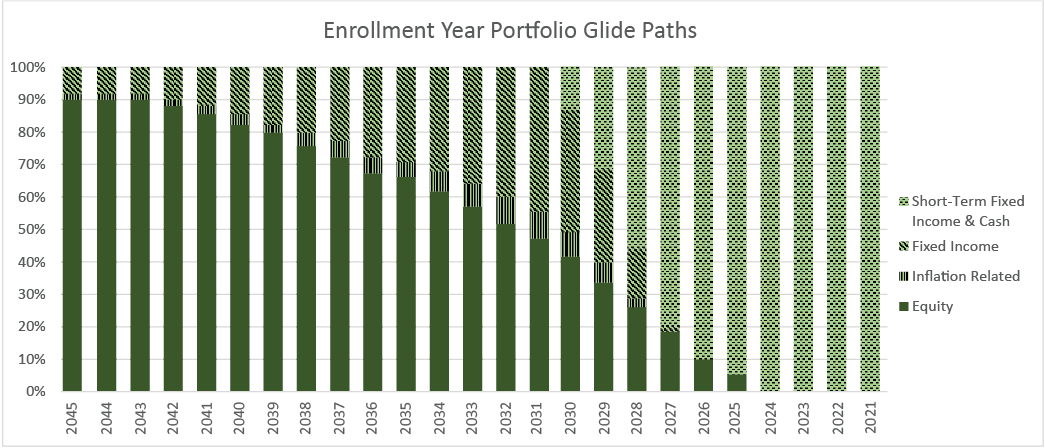
College Enrollment Year Investment Option 13
The Portfolios in the College Enrollment Year Investment Option begin with larger allocations to U.S. and international equity Funds. As the Beneficiary ages and approaches college age, the asset allocations shift away from equity Funds and into fixed-income Funds and the Money Market Fund.
11, 13 Allocations as of July 1, 2026
Portfolio Rebalancing
We perform systematic calculations to allocate daily cash flows to the Underlying Funds in an attempt to bring the Portfolios back to their target asset allocations. In addition, we will perform quarterly rebalancing to bring the Portfolios back to their target allocations.
College Enrollment Year Investment Option Portfolios
Objective
The Portfolios in the College Enrollment Year Investment Option seek to match the investment objective and level of risk to the investment horizon by taking into account the number of years before the Beneficiary is expected to need money from the account for higher education expenses.
Strategy
Each target College Enrollment Date Portfolio is designed to gradually reduce risk over time. The Portfolios will transition from a heavier allocation to Underlying Funds that invest in equities (stocks) in earlier years to more conservative Underlying Funds that invest in fixed income (bonds) and money market instruments (cash preservation) as the Beneficiary approaches college age. This change in allocations among Underlying Funds will take place quarterly. As a result, the risk profile of the Portfolio typically decreases over time, corresponding to its decreasing allocations to Underlying Funds invested in equities. This change in asset allocation over time is known as a "glidepath" that helps smooth the shift from capital accumulation in the earlier years to capital preservation later on.
Portfolios with more Underlying Funds invested in bonds and money market securities tend to be less volatile than those with a higher percentage of Underlying Funds invested in stocks. Less-volatile Portfolios generally will not decline as far when stock markets go down, but they also generally will not appreciate in value as much when stock markets go up. Each College Enrollment Date Portfolio invests in multiple Underlying Funds to various degrees. The percentage of each Portfolio's assets allocated to each Underlying Fund, as of July 1, 2026, is set forth in the table below:
| Vanguard Morningstar Total Stock Market Index Fund Inst Plus | Vanguard Total International Stock Index Fund Inst Plus | Vanguard Inflation-Protected Securities Fund Inst | Vanguard Total Bond Market Index Fund Institutional Plus | Vanguard Total International Bond Index Fund Inst | Vanguard Short-Term Bond Index Fund Inst Plus | Vanguard Short-Term Inflation-Protected Securities Index Fund Inst | Vanguard Treasury Money Market Fund | |
|---|---|---|---|---|---|---|---|---|
| VSMPX | VTPSX | VIPIX | VBMPX | VTIFX | VBIPX | VTSPX | VUSXX | |
| 2045 | 54.00% | 36.00% | 1.67% | 6.66% | 1.67% | – | – | – |
| 2044 | 54.00% | 36.00% | 1.67% | 6.66% | 1.67% | – | – | – |
| 2043 | 54.00% | 36.00% | 1.67% | 6.66% | 1.67% | – | – | – |
| 2042 | 52.80% | 35.20% | 2.00% | 8.00% | 2.00% | – | – | – |
| 2041 | 51.60% | 34.40% | 2.33% | 9.34% | 2.33% | – | – | – |
| 2040 | 49.80% | 33.20% | 2.83% | 11.34% | 2.83% | – | – | – |
| 2039 | 48.00% | 32.00% | 3.33% | 13.34% | 3.33% | – | – | – |
| 2038 | 45.60% | 30.40% | 4.00% | 16.00% | 4.00% | – | – | – |
| 2037 | 43.20% | 28.80% | 4.67% | 18.66% | 4.67% | – | – | – |
| 2036 | 41.16% | 27.44% | 5.23% | 20.94% | 5.23% | – | – | – |
| 2035 | 39.12% | 26.08% | 5.80% | 23.20% | 5.80% | – | – | – |
| 2034 | 37.20% | 24.80% | 6.33% | 25.34% | 6.33% | – | – | – |
| 2033 | 34.20% | 22.80% | 7.17% | 28.66% | 7.17% | – | – | – |
| 2032 | 31.20% | 20.80% | 8.00% | 32.00% | 8.00% | – | – | – |
| 2031 | 28.20% | 18.80% | 8.83% | 35.34% | 8.83% | – | – | – |
| 2030 | 24.80% | 16.53% | 7.61% | 30.45% | 7.61% | 7.50% | 5.50% | 0.00% |
| 2029 | 20.30% | 13.53% | 5.78% | 23.11% | 5.78% | 20.50% | 11.00% | 0.00% |
| 2028 | 15.00% | 10.00% | 3.33% | 13.34% | 3.33% | 35.00% | 20.00% | 0.00% |
| 2027 | 10.50% | 7.00% | 0.33% | 1.34% | 0.33% | 50.00% | 30.50% | 0.00% |
| 2026 | 6.00% | 4.00% | – | – | – | 30.00% | 30.00% | 30.00% |
| 2025 | 3.00% | 2.00% | – | – | – | 23.00% | 23.00% | 49.00% |
| 2024 | – | – | – | – | – | 14.50% | 14.50% | 71.00% |
| 2023 | – | – | – | – | – | 5.00% | 5.00% | 90.00% |
| 2022 | – | – | – | – | – | 5.00% | 5.00% | 90.00% |
| 2021 | – | – | – | – | – | – | – | 100.00% |
To varying degrees, certain College Enrollment Date Portfolios invest in certain Underlying Funds that invest primarily in equity securities. As each Portfolio approaches closer to the college enrollment date, the investment in these Underlying Funds will decrease. Through these Underlying Funds, the Portfolios intend to indirectly allocate varying percentages of its assets to:
- Equity securities of U.S. companies across all capitalization ranges; and
- Equity securities of foreign issuers, including both foreign issuers located in developed countries and foreign issuers located in emerging market countries.
Also to varying degrees, certain College Enrollment Date Portfolios invest in certain Underlying Funds that invest primarily in fixed-income or other types of debt securities. As a Portfolio approaches closer to the college enrollment date, the investment in these Underlying Funds will generally increase.
Through these Underlying Funds, the Portfolios intend to indirectly allocate varying percentages of its assets to:
- A wide spectrum of public, investment-grade, taxable debt securities denominated in U.S. dollars, including government securities, as well as mortgage-backed, commercial mortgage-backed, and asset- backed securities;
- U.S. government, investment-grade corporate, and investment-grade dollar-denominated bonds that have maturities between 1 and 5 years;
- A selection of global, investment-grade, fixed-rate debt securities, including government, government agency, corporate, and securitized non-U.S. investment-grade fixed income investments, all issued in currencies other than the U.S. dollar and with maturities of more than one year;
- High-quality, short term money market instruments; and
- Inflation-protected public obligations issued by the U.S. Treasury with remaining maturities of less than five years.
Risks
The Portfolios may be subject to the following risks:
- Because the Portfolios invest in stock Funds, the Portfolios are subject to Stock Market Risk. The Portfolios are also subject to high levels of Country/Regional Risk, Currency Risk, and Emerging Markets Risk. The Portfolios also have Investment Style Risk, Index Sampling Risk, and Derivatives Risk.
- Because the Portfolios invest in bond Funds, the Portfolios are subject to Interest Rate Risk, Credit Risk, Income Risk, Call Risk, Prepayment Risk, and Extension Risk. The Portfolios also have low Country/Regional Risk, Currency Risk, Emerging Markets Risk, Currency Hedging Risk, Non- Diversification Risk, Index Sampling Risk, and Derivatives Risk.
Static Investment Option Portfolios 14
Unlike the College Enrollment Year Portfolios, Static Portfolios are not automatically reallocated to more conservative investments as the Beneficiary ages. Instead, Static Portfolio investments remain fixed, subject to periodic rebalancing back to the Portfolio guidelines and to any change by the Board in the Portfolio investment guidelines.
If you choose to invest in Static Portfolios that invest in Underlying Funds with a significant weighting in stocks, such as the Target Risk Aggressive Portfolio, you should consider moving your assets to the more conservative Static Portfolios that invest more heavily in bond Funds and/or the FDIC-Insured cash option as your Beneficiary approaches college age. Please note that there are limitations on your ability to move assets from one Portfolio to another.
The Static Portfolios offer the following fourteen (14) Portfolios.
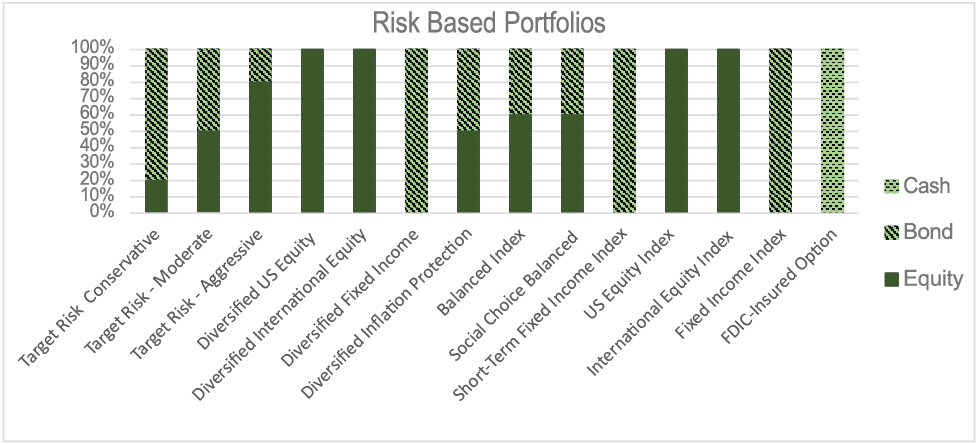
12, 14 Allocations as of July 1, 2026
Target Risk Conservative
Objective
This Investment Portfolio seeks a conservative to moderate total return. The Portfolio is designed for investors with a moderately low tolerance for short-term market fluctuations who expect some capital appreciation and have some desire for current income. The Portfolio investments include a blend of globally diversified equity securities with exposure to a mix of bonds.
Strategy
This Portfolio invests in Underlying Funds as follows:
| Fund Name | Ticker | Allocation |
|---|---|---|
| Vanguard Morningstar Total Stock Market Index Fund Inst Plus | VSMPX | 12.0% |
| Vanguard Total International Stock Index Fund Inst Plus | VTPSX | 8.0% |
| Vanguard Inflation-Protected Securities Fund Inst | VIPIX | 7.0% |
| Vanguard Total Bond Market Index Fund Inst Plus | VBMPX | 31.0% |
| Vanguard Total International Bond Index Fund Inst | VTIFX | 7.0% |
| Vanguard Short-Term Bond Index Fund Inst Plus | VBIPX | 25.0% |
| Vanguard Short-Term Inflation-Protected Securities Index Inst | VTSPX | 10.0% |
Through its investments in the Underlying Funds above, this Investment Portfolio intends to indirectly allocate its assets to:
- equity securities of U.S. companies across all capitalization ranges;
- equity securities of foreign issuers, including both foreign issuers located in developed countries and foreign issuers located in emerging market countries;
- a wide spectrum of public, investment-grade, taxable debt securities denominated in U.S. dollars, including government securities, as well as mortgage-backed, commercial mortgage-backed, and asset- backed securities;
- debt securities, the principal value of which increases or decreases based on changes in the Consumer Price Index for All Urban Consumers over the life of the securities (typically, U.S. Treasury Inflation Indexed Securities, but also including inflation-linked bonds of foreign issuers or inflation linked bonds that are issued or guaranteed by U.S. and non-U.S. public or private sector entities);
- a selection of global, investment-grade, fixed-rate debt securities, including government, government agency, corporate, and securitized non-U.S. investment-grade fixed income investments, all issued in currencies other than the U.S. dollar and with maturities of more than one year.
Risks
Through its investments in the Underlying Funds above, this Investment Portfolio is subject to the following risks to varying degrees: Active Management Risk; Call Risk; Cash and Cash Equivalents Risk; Credit Risk; Currency Risk; Currency Hedging Risk; Derivatives Risk; Emerging Markets Risk; Extension Risk; Fixed-Income Foreign Investment Risk; Foreign Government Debt Risk; Foreign Investment Risk; Futures Contracts Risk; High Yield Risk; Income Volatility Risk; Index Risk; Index Sampling Risk; Interest Rate Risk; Investment Company Investment Risk; Issuer Risk; Large-Cap Risk; Leverage Risk; Liquidity Risk; Market Risk; Market Volatility, Liquidity, and Valuation Risk; Mid-Cap Risk; Portfolio Turnover Risk; Prepayment Risk; Real Estate Investing Risk; Regulatory Risk; Repurchase Agreement Risk; Securities Lending Risk; Small-Cap Risk; Special Risks for Inflation-Indexed Bonds; Subsidiary Risk; Swap Agreements Risk; Tax Risk; U.S. Government Securities Risk; and Valuation Risk.
Target Risk Moderate
Objective
This Investment Portfolio seeks a moderate total return. The Portfolio is designed for investors with a moderate tolerance for short-term market fluctuations who expect some capital appreciation and have some desire for current income. The Portfolio investments include a blend of globally diversified equity securities with exposure to a mix of bonds.
Strategy
This Portfolio invests primarily in Underlying Funds as follows:
| Fund Name | Ticker | Allocation |
|---|---|---|
| Vanguard Morningstar Total Stock Market Index Fund Inst Plus | VSMPX | 30.0% |
| Vanguard Total International Stock Index Fund Inst Plus | VTPSX | 20.0% |
| Vanguard Inflation Protected Securities Fund Inst | VIPIX | 8.0% |
| Vanguard Total Bond Market Index Fund Inst Plus | VBMPX | 34.0% |
| Vanguard Total International Bond Index Fund Inst | VTIFX | 8.0% |
Through its investments in the Underlying Funds above, this Investment Portfolio intends to indirectly allocate its assets to:
- equity securities of U.S. companies across all capitalization ranges;
- equity securities of foreign issuers, including both foreign issuers located in developed countries and foreign issuers located in emerging market countries;
- a wide spectrum of public, investment-grade, taxable debt securities denominated in U.S. dollars, including government securities, as well as mortgage-backed, commercial mortgage-backed, and asset- backed securities;
- debt securities, the principal value of which increases or decreases based on changes in the Consumer Price Index for All Urban Consumers over the life of the securities (typically, U.S. Treasury Inflation Indexed Securities, but also including inflation-linked bonds of foreign issuers or inflation linked bonds that are issued or guaranteed by U.S. and non-U.S. public or private sector entities);
- a selection of global, investment-grade, fixed-rate debt securities, including government, government agency, corporate, and securitized non-U.S. investment-grade fixed income investments, all issued in currencies other than the U.S. dollar and with maturities of more than one year.
Risks
Through its investments in the Underlying Funds above, this Investment Portfolio is subject to the following risks to varying degrees: Active Management Risk; Call Risk; Cash and Cash Equivalents Risk; Credit Risk; Currency Risk; Currency Hedging Risk; Derivatives Risk; Emerging Markets Risk; Extension Risk; Fixed-Income Foreign Investment Risk; Foreign Government Debt Risk; Foreign Investment Risk; Futures Contracts Risk; High Yield Risk; Income Volatility Risk; Index Risk; Index Sampling Risk; Interest Rate Risk; Investment Company Investment Risk; Issuer Risk; Large-Cap Risk; Leverage Risk; Liquidity Risk; Market Risk; Market Volatility, Liquidity, and Valuation Risk; Mid-Cap Risk; Portfolio Turnover Risk; Prepayment Risk; Real Estate Investing Risk; Regulatory Risk; Repurchase Agreement Risk; Securities Lending Risk; Small-Cap Risk; Special Risks for Inflation-Indexed Bonds; Subsidiary Risk; Swap Agreements Risk; Tax Risk; U.S. Government Securities Risk; and Valuation Risk.
Target Risk Aggressive
Objective
This Investment Portfolio seeks a high total return. The Portfolio is designed for investors with a high tolerance for short-term market fluctuations who expect significant capital appreciation and have little desire for current income. The Portfolio investments include a blend of globally diversified equity securities with exposure to a mix of bonds.
Strategy
This Portfolio invests primarily in Underlying Funds as follows:
| Fund Name | Ticker | Allocation |
|---|---|---|
| Vanguard Morningstar Total Stock Market Index Fund Inst Plus | VSMPX | 48.0% |
| Vanguard Total International Stock Index Fund Inst Plus | VTPSX | 32.0% |
| Vanguard Inflation-Protected Securities Fund Inst | VIPIX | 3.0% |
| Vanguard Total Bond Market Index Fund Inst Plus | VBMPX | 14.0% |
| Vanguard Total International Bond Index Fund Inst | VTIFX | 3.0% |
Through its investments in the Underlying Funds above, this Investment Portfolio intends to indirectly allocate its assets to:
- equity securities of U.S. companies across all capitalization ranges;
- equity securities of foreign issuers, including both foreign issuers located in developed countries and foreign issuers located in emerging market countries;
- a wide spectrum of public, investment-grade, taxable debt securities denominated in U.S. dollars, including government securities, as well as mortgage-backed, commercial mortgage-backed, and asset- backed securities;
- debt securities, the principal value of which increases or decreases based on changes in the Consumer Price Index for All Urban Consumers over the life of the securities (typically, U.S. Treasury Inflation Indexed Securities, but also including inflation-linked bonds of foreign issuers or inflation linked bonds that are issued or guaranteed by U.S. and non-U.S. public or private sector entities);
- a selection of global, investment-grade, fixed-rate debt securities, including government, government agency, corporate, and securitized non-U.S. investment-grade fixed income investments, all issued in currencies other than the U.S. dollar and with maturities of more than one year.
Risks
Through its investments in the Underlying Funds above, this Investment Portfolio is subject to the following risks to varying degrees: Active Management Risk; Call Risk; Cash and Cash Equivalents Risk; Credit Risk; Currency Risk; Currency Hedging Risk; Derivatives Risk; Emerging Markets Risk; Extension Risk; Fixed-Income Foreign Investment Risk; Foreign Government Debt Risk; Foreign Investment Risk; Futures Contracts Risk; High Yield Risk; Income Volatility Risk; Index Risk; Index Sampling Risk; Interest Rate Risk; Investment Company Investment Risk; Issuer Risk; Large-Cap Risk; Leverage Risk; Liquidity Risk; Market Risk; Market Volatility, Liquidity, and Valuation Risk; Mid-Cap Risk; Portfolio Turnover Risk; Prepayment Risk; Real Estate Investing Risk; Regulatory Risk; Repurchase Agreement Risk; Securities Lending Risk; Small-Cap Risk; Special Risks for Inflation-Indexed Bonds; Subsidiary Risk; Swap Agreements Risk; Tax Risk; U.S. Government Securities Risk; and Valuation Risk.
Diversified U.S. Equity
Objective
This Investment Portfolio seeks to provide a favorable long-term total return by investing in a combination of index, quantitative and actively managed U.S. equity Underlying Funds.
Strategy
This Portfolio invests primarily in Underlying Funds as follows:
| Fund Name | Ticker | Allocation |
|---|---|---|
| LSV Value Equity | LSVEX | 30.0% |
| Vanguard Institutional Index I | VINIX | 30.0% |
| T. Rowe Price Lg Cap Grow | TRLGX | 25.0% |
| Champlain Mid Cap Inst | CIPIX | 10.0% |
| DFA U.S. Small Cap | DFSTX | 5.0% |
Through its investments in the Underlying Funds above, this Investment Portfolio intends to indirectly allocate its assets to a diversified portfolio of equity securities of mostly U.S. companies across all capitalization ranges. A small percentage of the Investment Portfolio's assets may be indirectly allocated to foreign securities and a small percentage of the Investment Portfolio's assets may be invested in derivative instruments.
Risks
Through its investments in the Underlying Funds above, this Investment Portfolio is subject to Active Management Risk; Derivatives Risk; Foreign Investing Risk; Growth Investing Risk; Index Risk; Issuer Risk; Large-Cap Risk; Market Risk; Mid-Cap Risk; Price Volatility Risk; Securities Lending Risk; Small-Cap Risk; and Value Investing Risk.
Diversified International Equity
Objective
This Investment Portfolio seeks to provide a favorable long-term total return by investing in a combination of index and actively-managed international equity Underlying Funds.
Strategy
This Investment Portfolio invests 100% of its assets in Underlying Funds that invest primarily in equity securities of non-U.S. issuers. The percentages of the Investment Portfolio's assets allocated to each Underlying Fund are:
| Fund Name | Ticker | Allocation |
|---|---|---|
| Vanguard Intl Growth Adm | VWILX | 25.0% |
| Vanguard Total Intl Stock Index Inst Plus | VTPSX | 22.5% |
| Vanguard Emerging Mkt Index Adm | VEMAX | 5.0% |
| DFA International Small Company I | DFISX | 7.5% |
| Dodge & Cox International Stock I | DODFX | 40.0% |
Through its investments in the Underlying Funds above, this Investment Portfolio intends to indirectly allocate its assets to equity securities (including convertible securities) of non-U.S. issuers, across all capitalization ranges, located in developed and emerging market countries.
Risks
Through its investments in the Underlying Funds above, this Investment Portfolio is subject to Active Management Risk; Convertible Securities Risk; Counterparty Risk; Credit Risk; Currency Risk; Currency Hedging Risk; Emerging Market Risk; Foreign Currency Forward Risk; Foreign Investment Risk; Futures Contracts Risk; Index Risk; Interest Rate Risk; Investment Company Investment Risk; Issuer Risk; Liquidity Risk; Market Risk; Large-Cap Risk; Mid-Cap Risk; Securities Lending Risk; Segregated Assets Risk; Small-Cap Risk; Valuation Risk; and Value Investing Risk.
Diversified Fixed Income
Objective
This Investment Portfolio seeks to provide a moderate long-term rate of return primarily through current income.
Strategy
This Investment Portfolio invests 100% of its assets in Underlying Funds that invest primarily in fixed income instruments. The percentages of this Investment Portfolio's assets allocated to each mutual fund are:
| Fund Name | Ticker | Allocation |
|---|---|---|
| Dodge & Cox Income | DODIX | 40.0% |
| Double Line Core Fixed I | DBLFX | 40.0% |
| Vanguard Total Bond Market Index Inst Plus | VBMPX | 20.0% |
Through its investments in the Underlying Funds above, this Investment Portfolio intends to indirectly allocate a majority of its assets to a wide spectrum of investment grade, taxable debt securities, and other fixed income instruments, including government securities, as well as mortgage-backed, commercial mortgage-backed and asset-backed securities. Fixed income instruments may include forward contracts, derivatives such as options, futures contracts or swap agreements, purchase and sale contracts or other investment techniques (such as buy backs or dollar rolls), and bank loans and assignments. A portion of the Portfolio's assets may be indirectly allocated to high yield securities (commonly referred to as "junk bonds"), securities of foreign issuers, including securities denominated in foreign currencies and from emerging market countries, derivative instruments, and equity related securities such as preferred stock and convertible securities.
Risks
Through its investments in the Underlying Funds above, this Investment Portfolio is subject to Active Management Risk; Call Risk; Convertible Securities Risk; Credit Risk; Currency Risk; Default Risk; Derivatives Risk; Emerging Markets Risk; Extension Risk; Financial Services Risk; Foreign Investment Risk; High Yield Risk; Index Risk; Income Volatility Risk; Interest Rate Risk; Issuer Risk; Leverage Risk; Market Risk; Market Volatility, Liquidity, and Valuation Risk; Mortgage-Related and Other Asset-Backed Risk; Prepayment Risk; Real Estate Risk; Sector Selection Risk; Special Risks for Inflation-Indexed Bonds; and U.S. Government Securities Risk.
Diversified Inflation Protection
Objective
This Investment Portfolio seeks a long-term rate of return that outpaces inflation.
Strategy
This Investment Portfolio invests in four different Underlying Funds. The Underlying Funds in which this Investment Portfolio is invested are:
| Fund Name | Ticker | Allocation |
|---|---|---|
| DFA Global Real Estate | DFGEX | 25.0% |
| DFA Commodity Strat Inst | DCMSX | 25.0% |
| Vanguard Inflation-Protected Securities Inst | VIPIX | 25.0% |
| Vanguard ST Inflation-Protected Securities Inst | VTSPX | 25.0% |
Through its investments in the Underlying Funds above, this Investment Portfolio intends to indirectly allocate its assets to:
- debt securities, the principal value of which increases or decreases based on changes in the Consumer Price Index for All Urban Consumers over the life of the securities (typically, U.S. Treasury Inflation Indexed Securities, but also including inflation-linked bonds of foreign issuers or inflation linked bonds that are issued or guaranteed by U.S. and non-U.S. public or private sector entities);
- stocks of publicly traded equity real estate investment trusts (known as REITs);
- a combination of commodity-linked derivative instruments and fixed income securities;
- money market instruments with a remaining maturity of 60 days or less.
Risks
Through its investment in the Underlying Funds above, this Investment Portfolio is subject to Active Management Risk; Cash and Cash Equivalents Risk; Commodity Risk; Credit Risk; Credit Risk for Floating Rate Loan Funds; Currency Risk; Currency Hedging Risk; Derivatives Risk; Fixed-Income Foreign Investment Risk; Foreign Government Debt Risk; Foreign Investment Risk; Futures Contracts Risk; Index Risk; Interest in Loans Risk; Interest Rate Risk; Leverage Risk; Leverage Risk for Liquidity Risk; Market Risk; Mid-Cap Risk; Portfolio Turnover Risk; Real Estate Investing Risk; Regulatory Risk; Repurchase Agreement Risk; Securities Lending Risk; Small-Cap Risk; Special Risks for Inflation-Indexed Bonds; Subsidiary Risk; Swap Agreements Risk; Tax Risk; and U.S. Government Securities Risk.
Balanced Index
Objective
This Investment Portfolio seeks to provide a favorable return that reflects the broad investment performance of the financial markets.
Strategy
This Investment Portfolio invests 100% of its assets in "index funds," meaning that the funds attempt to track a benchmark index. The percentages of this Investment Portfolio's assets allocated to each Underlying Fund are:
| Fund Name | Ticker | Allocation |
|---|---|---|
| Vanguard Morningstar Total Stock Market Index Fund Inst Plus | VSMPX | 36.0% |
| Vanguard Total International Stock Index Fund Inst Plus | VTPSX | 24.0% |
| Vanguard Total Bond Market Index Fund Inst Plus | VBMPX | 40.0% |
Through its investments in the Underlying Funds above, this Investment Portfolio intends to indirectly allocate its assets to equity securities of U.S. companies across all capitalization ranges and to a wide spectrum of public, investment-grade, taxable debt securities denominated in U.S. dollars, including government securities, as well as mortgage-backed, commercial mortgage-backed and asset-backed securities.
Risks
Through its investments in the Underlying Funds above, this Investment Portfolio is subject to the following risks to varying degrees: Active Management Risk; Call Risk; Cash and Cash Equivalents Risk; Credit Risk; Currency Risk; Currency Hedging Risk; Derivatives Risk; Emerging Markets Risk; Extension Risk; Fixed-Income Foreign Investment Risk; Foreign Government Debt Risk; Foreign Investment Risk; Futures Contracts Risk; High Yield Risk; Income Volatility Risk; Index Risk; Index Sampling Risk; Interest Rate Risk; Investment Company Investment Risk; Issuer Risk; Large-Cap Risk; Leverage Risk; Liquidity Risk; Market Risk; Market Volatility, Liquidity, and Valuation Risk; Mid-Cap Risk; Portfolio Turnover Risk; Prepayment Risk; Real Estate Investing Risk; Regulatory Risk; Repurchase Agreement Risk; Securities Lending Risk; Small-Cap Risk; Special Risks for Inflation-Indexed Bonds; Subsidiary Risk; Swap Agreements Risk; Tax Risk; U.S. Government Securities Risk; and Valuation Risk.
Social Choice Balanced
Objective
This Investment Portfolio seeks to provide a favorable return that reflects the broad investment performance of the financial markets.
Strategy
This Portfolio invests primarily in Underlying Funds that meet certain social criteria, such as product safety, corporate citizenship, human rights, and environmental performance as follows:
| Fund Name | Ticker | Allocation |
|---|---|---|
| Nuveen Large Cap Responsible Equity | TISCX | 36.0% |
| DFA Intl Social Equity | DSCLX | 18.0% |
| DFA Emerging Markets Social | DFESX | 6.0% |
| Nuveen Core Impact Bond | TSBIX | 20.0% |
| DFA Social Fixed Income | DSFIX | 20.0% |
Through its investments in the Underlying Funds above, this Investment Portfolio intends to indirectly allocate its assets to equity securities of U.S. companies across all capitalization ranges and to a wide spectrum of public, investment-grade, taxable debt securities denominated in U.S. dollars, including government securities, as well as mortgage-backed, commercial mortgage-backed and asset-backed securities.
Risks
Through its investments in the Underlying Funds above, this Investment Portfolio is subject to the following risks to varying degrees: Active Management Risk; Call Risk; Cash and Cash Equivalents Risk; Credit Risk; Currency Risk; Currency Hedging Risk; Derivatives Risk; Emerging Markets Risk; Extension Risk; Fixed-Income Foreign Investment Risk; Foreign Government Debt Risk; Foreign Investment Risk; Futures Contracts Risk; High Yield Risk; Income Volatility Risk; Index Risk; Index Sampling Risk; Interest Rate Risk; Investment Company Investment Risk; Issuer Risk; Large-Cap Risk; Leverage Risk; Liquidity Risk; Market Risk; Market Volatility, Liquidity, and Valuation Risk; Mid-Cap Risk; Portfolio Turnover Risk; Prepayment Risk; Real Estate Investing Risk; Regulatory Risk; Repurchase Agreement Risk; Securities Lending Risk; Small-Cap Risk; Special Risks for Inflation-Indexed Bonds; Subsidiary Risk; Swap Agreements Risk; Tax Risk; U.S. Government Securities Risk; and Valuation Risk.
Short Term Fixed Income Index
Objective
This Investment Portfolio seeks to provide a low long-term rate of return primarily through current income.
Strategy
This Investment Portfolio invests 100% of its assets in an "index fund," meaning that the fund attempts to track a benchmark index. The Underlying Fund in which this Investment Portfolio is invested is:
| Fund Name | Ticker | Allocation |
|---|---|---|
| Vanguard Short-Term Bond Index Fund Inst Plus | VBIPX | 100.0% |
Through its investment in the Underlying Fund above, this Investment Portfolio intends to indirectly allocate its assets to a wide spectrum of public, investment-grade, taxable debt securities denominated in U.S. dollars, including government securities, as well as mortgage- backed, commercial mortgage-backed, and asset-backed securities with maturity dates between 1 and 5 years.
Risks
Through its investment in the Underlying Fund above, this Investment Portfolio is subject to Call Risk; Credit Risk; Extension Risk; Fixed-Income Foreign Investment Risk; Income Volatility Risk; Index Risk; Interest Rate Risk; Market Volatility, Liquidity, and Valuation Risk; and Prepayment Risk.
U.S. Equity Index
Objective
This Investment Portfolio seeks to provide a favorable long-term total return, mainly from capital appreciation.
Strategy
This Investment Portfolio invests 100% of its assets in an "index fund," meaning that the Underlying Fund attempts to track a benchmark index. The Underlying Fund in which this Investment Portfolio is invested is:
| Fund Name | Ticker | Allocation |
|---|---|---|
| Vanguard Morningstar Total Stock Market Index Fund Inst Plus | VSMPX | 100.0% |
Through its investment in the Underlying Fund above, this Investment Portfolio intends to indirectly allocate its assets to domestic equity securities across all capitalization ranges.
Risks
Through its investment in the Underlying Fund above, this Investment Portfolio is subject to Index Risk; Issuer Risk; Large-Cap Risk; Market Risk; Mid-Cap Risk; and Small-Cap Risk.
International Equity Index
Objective
This Investment Portfolio seeks to provide favorable long-term growth, mainly from capital appreciation.
Strategy
This Investment Portfolio invests 100% of its assets in an "index fund," meaning that the Underlying Fund attempts to track a benchmark index. The Underlying Fund in which this Investment Portfolio is invested is:
| Fund Name | Ticker | Allocation |
|---|---|---|
| Vanguard Total International Stock Index Fund Inst Plus | VTPSX | 100.0% |
Through its investment in the Underlying Fund above, this Investment Portfolio intends to indirectly allocate its assets to equity securities of foreign issuers located in both developed and emerging market countries.
Risks
Through its investment in the Underlying Fund above, this Investment Portfolio is subject to Currency Risk; Emerging Markets Risk; Foreign Investment Risk; Market Risk; Large-Cap Risk; Mid-Cap Risk; and Small-Cap Risk.
Fixed Income Index
Objective
The Investment Portfolio seeks to provide a moderate long-term rate of return primarily through current income.
Strategy
This Investment Portfolio invests 100% of its assets in an "index fund," meaning that the fund attempts to track a benchmark index. The Underlying Fund in which this Investment Portfolio is invested is:
| Fund Name | Ticker | Allocation |
|---|---|---|
| Vanguard Total Bond Market Index Fund Inst Plus | VBMPX | 100.0% |
Through its investment in the Underlying Fund above, this Investment Portfolio intends to indirectly allocate its assets to a wide spectrum of public, investment-grade, taxable debt securities denominated in U.S. dollars, including government securities, as well as mortgage- backed, commercial mortgage-backed, and asset-backed securities.
Risks
Through its investment in the Underlying Fund above, this Investment Portfolio is subject to Call Risk; Credit Risk; Extension Risk; Fixed-Income Foreign Investment Risk; Income Volatility Risk; Index Risk; Interest Rate Risk; Market Volatility, Liquidity, and Valuation Risk; and Prepayment Risk.
FDIC-Insured Option
Objective
The Cash Option is designed to protect the principal contributed to your 529 Account.
Strategy
The Cash Option deposits 100% of its funds into an FDIC-insured account with The Bank of New York Mellon (the "Bank").
| Fund Name | Allocation |
|---|---|
| BNY Mellon Cash Deposit | 100.0% |
Risks
Representatives of the Federal Deposit Insurance Corporation have indicated that contributions to and earnings on an FDIC-insured bank account held by a trust such as the Trust will be insured by the FDIC on a pass-through basis to each Beneficiary under existing or amended FDIC regulations, subject to applicable insurance limits and compliance with applicable record- keeping requirements. Accordingly, contributions to and earnings on the FDIC-Insured cash option are insured by the FDIC on a pass-through basis to each Beneficiary in the same manner as other deposits held by the Beneficiary at the Bank in the same ownership right and capacity. (For this purpose, accounts established by a custodian for a minor under UTMA or UGMA are aggregated for insurance purposes with all other accounts with the Bank held by the minor.) FDIC insurance generally protects up to $250,000 of your deposits at the same bank in the same ownership right and capacity, so the portion of your 529 Account invested in the FDIC- Insured cash option, taken together with other deposits you hold in a single ownership basis at the Bank, will be insured up to $250,000.
Interest Rates
Interest on the Bank Account will be accrued daily and credited by the Bank on the last business day of each month based on the average daily balance on deposit in the Bank Account during such month. The gross interest rate on the Bank Account will be a rate equal to the upper end of the Federal Funds target rate range established by the Federal Reserve's Federal Open Market Committee ("FOMC"), less 15 basis points. A State Administration Fee of 20 basis points will be levied against this gross interest rate to yield the net interest rate paid. The FOMC normally meets eight times a year, and may also hold additional meetings and implement target rate range changes outside of its normal schedule. The State Administration Fee is subject to reduction if its application would cause a negative return on the Cash Option.
If the net interest rate paid on the Bank Account for any period is less than or equal to the State Administrative Fee for such period, the net interest accrual on Units in the Cash Option for such period will be zero. If the net interest rate paid on the Bank Account for any period is less than the State Administrative Fee for such period, the Board will waive the portion of the State Administrative Fee that exceeds such interest rate so that the State Administrative Fee shall not cause a negative return on amounts contributed to the Cash Option.
Underlying Fund Descriptions
The following profiles highlight the investment objective, strategy, and a summary of the main risks of each of the Underlying Funds in which both the College Enrollment Year and the Static Portfolios invest. The Portfolios in Embark are more likely to meet their goals if each Underlying Fund in which each Portfolio invests achieves its stated investment objectives.
The information provided in this Plan Disclosure Booklet and other information in the links below has been prepared by or on behalf of the applicable Underlying Fund by its Investment Manager and has been derived from the applicable Underlying Fund prospectuses. The Program Administrators assume no responsibility for its accuracy or completeness.
Underlying Funds
Morningstar Total Stock Market Index Fund Institutional Plus Shares • VSMPX
Visit https://advisors.vanguard.com/ and look up ticker VSMPX for details on the fund risks.
Total International Stock Index Fund Institutional Plus Shares • VTPSX
Visit https://advisors.vanguard.com/ and look up ticker VTPSX for details on the fund risks.
Inflation-Protected Securities Fund Institutional Shares • VIPIX
Visit https://advisors.vanguard.com/ and look up ticker VIPIX for details on the fund risks.
Global Real Estate Securities Portfolio • DFGEX
Visit https://us.dimensional.com/ and look up ticker DFGEX for details on the fund risks.
Commodity Strategy Portfolio • DCMSX
Visit https://us.dimensional.com/ and look up ticker DCMSX for details on the fund risks.
Total Bond Market Index Fund Institutional Plus Shares • VBMPX
Visit https://advisors.vanguard.com/ and look up ticker VBMPX for details on the fund risks.
Total International Bond Index Fund Institutional Shares • VTIFX
Visit https://advisors.vanguard.com/ and look up ticker VTIFX for details on the fund risks.
Vanguard Short-Term Bond Index Fund Institutional Plus Shares • VBIPX
Visit https://advisors.vanguard.com/ and look up ticker VBIPX for details on the fund risks.
Short-Term Inflation-Protected Securities Index Fund Institutional Shares • VTSPX
Visit https://advisors.vanguard.com/ and look up ticker VTSPX for details on the fund risks.
Treasury Money Market Fund • VUSXX
Visit https://advisors.vanguard.com/ and look up ticker VUSXX for details on the fund risks.
LSV Value Equity Fund • LSVEX
Visit https://lsvasset.com/ and look up ticker LSVEX for details on the fund risks.
Institutional Index Fund Institutional Shares • VINIX
Visit https://advisors.vanguard.com and look up ticker VINIX for details on the fund risks.
Institutional Large-Cap Growth Fund • TRLGX
Champlain Mid Cap Fund • CIPIX
Visit https://cipvt.com and look up ticker CIPIX for details on the fund risks.
U.S. Small Cap Portfolio • DFSTX
Visit https://us.dimensional.com and look up ticker DFSTX for details on the fund risks.
International Growth Fund Admiral Shares • VWILX
Visit https://advisors.vanguard.com and look up ticker VWILX for details on the fund risks.
Emerging Markets Stock Index Fund Admiral Shares • VEMAX
Visit https://advisors.vanguard.com and look up ticker VEMAX for details on the fund risks.
Dodge & Cox Income Fund • DODIX
Visit https://www.dodgeandcox.com and look up ticker DODIX for details on the fund risks.
Core Fixed Income • DBLFX
Visit https://doublelinefunds.com and look up ticker DBLFX for details on the fund risks.
Nuveen Large Cap Responsible Equity Fund • TISCX
Visit https://www.nuveen.com/ and look up ticker TISCX for details on the fund risks.
International Social Core Equity Portfolio • DSCLX
Visit https://us.dimensional.com and look up ticker DSCLX for details on the fund risks.
Emerging Markets Social Core Equity Portfolio • DFESX
Visit https://us.dimensional.com and look up ticker DFESX for details on the fund risks.
Nuveen Core Impact Bond Fund • TSBIX
Visit https://www.nuveen.com/ and look up ticker TSBIX for details on the fund risks.
Social Fixed Income Portfolio • DSFIX
Visit https://us.dimensional.com and look up ticker DSFIX for details on the fund risks.
DFA International Small Company Portfolio • DFISX
Visit https://www.dimensional.com and look up ticker DFISX for details on the fund risks.
Dodge & Cox International Stock Fund • DODFX
Visit https://www.dodgeandcox.com and look up ticker DODFX for details on the fund risks.
Additional Investment Information
Assets Held in Trust
Your Account assets are held in trust by the Board, a public instrumentality of the State of Oregon. We hold your Account for your exclusive benefit and we may not transfer or use it for any purpose other than those of the Program. Please keep in mind that you will not own shares of the Underlying Funds. You are purchasing Units in the Program's Portfolios, which invest your contributions in one or more of the Underlying Funds.
The Unit value of each Portfolio is normally calculated as of the close of the NYSE each Business Day. If securities held by an Underlying Fund are traded in other markets on days when the NYSE is closed, a Portfolio's value may fluctuate on days when you do not have access to your Portfolio to purchase or redeem Units. If events that are expected to materially affect the value of securities traded in other markets occur between the close of those markets and the close of business of the NYSE, those securities may be valued at their fair value.
Treatment of Dividends and Capital Gains
The Underlying Funds distribute dividends and capital gains because they are required to do so under the current provisions of the Code to maintain their tax status as regulated investment companies. The Portfolios are not considered mutual funds. Therefore, the Portfolios are not required to comply with these requirements. Any reinvested dividends and capital gains from the Underlying Funds will become assets of the Portfolios. Although the Underlying Funds may distribute dividends and/or capital gains, the Portfolios, rather than distributing earnings, reflect changes in value from income and gains and losses on the sale of the Underlying Funds solely by increasing or decreasing their Unit Value.
The Target Indexes of Certain Underlying Funds May Change
Certain products of the Underlying Funds are index funds or are funds that invest in index funds. Each index Fund reserves the right to substitute a different index for the index it currently tracks.
This could happen if the current index is discontinued, if the index Fund's agreement with the sponsor of its current index is terminated, or for any other reason determined in good faith by the index Fund's board of trustees. In any such instance, a substitute index would measure substantially the same market segment (e.g., large-, mid-, or small-capitalization) as the current index.
Portfolio Changes
We may (i) change the asset allocations, policies, objectives, and guidelines of the Portfolios, (ii) change the selection of Underlying Funds in which each Portfolio invests, and (iii) modify, add, and close Portfolios, each at any time and without prior notice. If we make changes to the Portfolios, your contributions may be reinvested in a Portfolio that is different from your original Portfolio. Neither you, your Beneficiary, nor any contributor to your Account may direct the investments of the Underlying Funds of a Portfolio.
Requesting Additional Information about the Underlying Funds
We will invest your contributions to the Portfolios in one or more of the Underlying Funds. Please keep in mind that you will not own shares of the Underlying Funds. Instead, you will own interests in the trust established by the Enabling Legislation.
Additional information about the investment strategies and risks of each Underlying Fund is available in its current prospectus and Statement of Additional Information. You can request a copy of the current prospectus, the Statement of Additional Information, or the most recent semi-annual or annual report of any Underlying Fund by contacting the following:
| Fund Company | Phone | Website |
|---|---|---|
| Champlain | 1-866-773-3238 | cipvt.com |
| Dimensional Funds | 1-512-306-7400 | dimensional.com |
| DoubleLine | 1-877-354-6311 | doublelinefunds.com |
| Dodge & Cox | 1-415-981-1710 | dodgeandcox.com |
| LSV | 1-888-386-3578 | lsvasset.com |
| Nuveen | 1-800-257-8787 | nuveen.com/en-us/mutual-funds |
| T. Rowe Price | 1-800-225-5132 | troweprice.com/personal-investing/funds/mutual-funds |
| Vanguard | 1-877-308-8411 | investor.vanguard.com |
Investment Direction Control by Account Owner
Investment Selection
For each new contribution, you can select from any of the Portfolios when you make your contribution. The minimum allocation per selected Investment Option is $5 of the contribution amount. You should periodically assess, and if appropriate, adjust your investment choices with your time horizon, risk tolerance and investment objectives in mind.
Changing Portfolios
Once you select your Portfolio for a particular contribution, IRS rules provide that you can move money or transfer from one Portfolio to another up to two times per calendar year for the same Beneficiary.
You can change the allocation of your future contributions at any time.
Investment Performance
The Portfolios commenced operations in September 2018. We make certain Portfolio price and performance information available on www.EmbarkSavings.com. Alternatively, you can call a Customer Service Representative at 1-866-772-8464 to inquire about this information.
The performance of the Portfolios will differ from the performance of the Underlying Funds. Because the Portfolios have higher expense ratios than those of the Underlying Funds, over comparable periods of time, all other things being equal, a Portfolio would have lower performance than its comparable Underlying Fund. (Of course, the Underlying Funds do not offer the same tax advantages as the Portfolios.) Performance differences also are caused by differences in the trade dates of Portfolio purchases.
The Portfolio (other than the FDIC-Insured Portfolio) will use your money to purchase shares of an Underlying Fund. Depending on the amount of cash flow into or out of the Portfolio and whether the Underlying Fund is going up or down in value, this timing difference may cause the Portfolio's performance either to trail or exceed the Underlying Fund's performance.
Important Federal Tax Information
General
This Section describes some of the federal tax considerations you should be aware of when investing in Embark, is for information purposes only, and is based on relevant provisions of the Internal Revenue Code of 1986, as amended (Code), proposed regulations issued by the IRS, relevant legislative history, and official interpretations of applicable federal law as of the date of this Plan Disclosure Booklet.
The federal tax consequences associated with an investment in Embark can be complex. This discussion is by no means exhaustive and is not meant as tax advice, so you should not rely upon it but instead consult an independent tax advisor regarding the application of tax laws to your particular circumstances. You should not use Embark for the purposes of evading federal tax or tax penalties.
Some states may impose taxes and/or penalties on investments in, or withdrawals from, a Qualified Tuition Program offered by other states. These penalties and taxes may, in certain cases, have the effect of offsetting some or all of the federal tax benefits discussed below.
Risk of Tax Law Changes
The IRS has only issued proposed regulations and certain other guidance under Section 529. Final regulations could affect the tax considerations or require changes in the terms of Embark.
Federal Tax-Deferred Earnings
Any earnings on contributions are tax-deferred, which means your Account assets grow free of current federal income tax and are not subject to federal income tax if withdrawn to pay for Qualified Education Expenses, as described below.
Federal Gift/Estate Tax
If your contributions, together with any other gifts to the Beneficiary (over and above those made to your Account), do not exceed $19,000 per year ($38,000 for married couples making a proper election), those contributions will qualify for the annual exclusion from gift tax for that year. Gifts of up to $95,000 can be made in a single year ($190,000 for married couples making a proper election) for a Beneficiary and you may elect to apply the contribution against the annual exclusion equally over a five-year period. This allows you to move assets into tax- deferred investments and out of your estate more quickly.
If you die with assets remaining in your Account, the Account's value will generally not be included in your estate for federal estate tax purposes, unless you elect the five-year averaging and die before the end of the fifth year. If your Beneficiary dies, and assets remain in your Account, the value of your Account may be included in the Beneficiary's estate for federal tax purposes. Further rules regarding gifts and the generation-skipping transfer tax may apply in the case of distributions, changes of Beneficiaries, and other situations. The state law treatment of gift and estate taxes varies so you should check with your tax advisor for the specific effect of federal and state (if any) gift tax and generation skipping transfer tax in your situation.
Transfers and Rollovers
Where a distribution is placed in another Account or another Qualified Tuition Program within sixty (60) days of the distribution date, you may avoid incurring federal income tax or a Distribution Tax. You can transfer assets for the same Beneficiary from another Qualified Tuition Program to your Account without adverse tax consequences only if no other such rollovers have occurred within the prior twelve (12) months. Changes in your Beneficiary could potentially cause gift and/or generation-skipping transfer tax consequences to you and your Beneficiary. Because gift and generation-skipping transfer tax issues are complex, you should consult with your tax advisor.
ABLE Rollover Distributions
You may roll over all or part of the balance of your Embark Account into an Oregon ABLE Savings Plan, ABLE for ALL Savings Plan or other Qualified ABLE Program account within sixty (60) days of withdrawal without incurring any federal income tax or the Distribution Tax if:
- The rollover is to an account for the same beneficiary; or
- The rollover is for a new beneficiary who is a Member of the Family of the prior beneficiary
Any such rollover is subject to the eligibility requirements of the Qualified ABLE Program and to the contribution limits applicable to a Qualified ABLE Program.
Changes in your Beneficiary could potentially cause gift and/or generation-skipping transfer tax consequences to you and your Beneficiary. Because gift and generation-skipping transfer tax issues are complex, you should consult with your tax advisor.
Coverdell Education Savings Account (ESA)
Generally, contributions may be made to both an ESA (defined in Section 530 of the Code) and a Qualified Tuition Program in the same year on behalf of the same Beneficiary. However, the same educational expenses cannot be claimed for a tax-exempt distribution from both the ESA and the Qualified Tuition Program.
Education Tax Credits
You and your Beneficiary, if eligible, can take advantage of American Opportunity and Lifetime Learning Tax Credits without affecting your participation in Embark or its benefits.
American Opportunity and Lifetime Learning Credits can be claimed in the same year that a tax-exempt distribution is taken from a Qualified Tuition Program provided the distribution is not used for the same educational expenses.
All Distributions
Distributions may be comprised of: (1) principal, which is not taxable when distributed, and (2) earnings, if any, which may be subject to federal income tax. We determine the earnings portion based on IRS rules and report to the IRS and the recipient. However, we do not report whether the distribution is a Qualified Distribution, Non-Qualified Distribution, Other Distribution or Refunded Distribution. You are responsible for preparing and filing the appropriate forms when completing your federal income tax return and for paying any applicable tax directly to the IRS.
Qualified Expense Distributions
If you take a distribution from your Account to pay for Qualified Expenses, your Beneficiary generally does not have to include as income any earnings distributed for the applicable taxable year if the total distributions for that year are less than or equal to the total Qualified Expenses for that year minus any tax-free educational assistance and expenses considered in determining any American Opportunity or Lifetime Learning Credits claimed for that taxable year.
You, or your Beneficiary, as applicable, are responsible for determining the amount of the earnings portion of any distribution from your Account that may be taxable and are responsible for reporting any earnings that must be included in taxable income. You should consult with your tax advisor for further information.
Other Distributions
For federal income tax purposes, you, or the Beneficiary, may be subject to federal and state income tax on the earnings portion of a distribution in the event of a distribution on account of the death or Disability of a Beneficiary, the receipt by the Beneficiary of a scholarship, grant, or other tax-free educational assistance, attendance at certain specified U.S. service academies, or use of American Opportunity or Lifetime Learning Credits. The distributions discussed in this paragraph are not subject to the Distribution Tax.
Refunded Distributions
You may avoid incurring federal income tax or a Distribution Tax if you receive a Refunded Distribution.
Non-Qualified Distributions
You, or the Beneficiary, as applicable, are subject to federal and state income tax and the Distribution Tax on the earnings portion of any distribution that is not exempt from tax as described above.
Determination of Taxable Earnings
The principal and earnings portions of a distribution for federal tax purposes are determined by a formula reflecting the proportion of contributions to the overall market value of your accounts in all Qualified Tuition Programs sponsored by the State for the same Beneficiary. If the distribution is subject to federal income tax and/or a Distribution Tax, the tax is applied to the earnings portion. Due to the IRS rules regarding aggregation of Accounts, the taxable earnings may be more or less than the actual earnings on any particular Account or Accounts.
Important State of Oregon Tax Information
Oregon taxpayers are eligible to receive state income tax credit up to $380 for joint filers and $190 for single filers. The tax credit provides the same maximum credit to all Oregonians who are saving for college, trade school or any post-secondary education through Embark. Oregon taxpayers can make contributions up to April 15 and have those contributions count towards the previous year's state income tax credit.
Learn more about tax considerations associated with investing in Embark by thoroughly reviewing this section. Before you invest, you should consult an independent tax advisor regarding the application of tax laws to your particular circumstances.
General Information
Your Account
Your Enrollment or Enrollment Form, when executed by you, and the Plan Disclosure Booklet, which is incorporated into the Enrollment Form, constitute the entire contract between you and the Board with respect to your Account. By completing your Enrollment, you are requesting that the Board establish an Account for the benefit of the Beneficiary you designate during Enrollment. Your Account, the Plan Disclosure Booklet and your signed Enrollment Form are subject to the Enabling Legislation and any rules or policies the Board has adopted or may adopt under the Enabling Legislation. We will hold your Account assets, subject to the Enabling Legislation and the Code, the Plan Disclosure Booklet, and your signed Enrollment Form, for the exclusive benefit of you and the Beneficiary.
Customer Identification Verification
Federal law requires all financial institutions to obtain, verify and record information that identifies each person who opens an Account. When completing your Enrollment, we will ask for your name, street address, date of birth, and Social Security number or tax identification number (and that of any person(s) opening an Account on behalf of an Account Owner, such as a Custodian, agent under a power of attorney, trustee, or corporate officers). This information is necessary to properly verify the identity of the person(s) opening the Account. If we do not receive all required information, there could be a delay in opening your Account or we may not open an Account for you. We will use this information to verify your identity and if, after making reasonable efforts, we are unable to verify your identity, the U.S.A. Patriot Act allows us to take any action permitted by law, without prior notice to you, including rejecting contribution and transfer requests, suspending Account services, or closing the Account and refunding the Account at the Unit Value calculated the day the Account is closed. Any refund made under these circumstances may be considered a Non-Qualified Distribution. The risk of market loss, tax implications, and any other expenses as a result of the liquidation, will be solely your responsibility.
Suspension of Services
We reserve the right to (a) refuse, change, discontinue, or temporarily suspend Account services, including accepting contributions and processing distribution requests, for any reason, and (b) suspend the processing of distribution requests or postpone sending out the proceeds of a withdrawal request when the NYSE is closed for any reason other than its usual weekend or holiday closings, when trading is restricted by the SEC, or under any emergency circumstances.
Changes to an Account
We are not responsible for the accuracy of the documentation you submit to us to make changes to your Account, whether submitted online or in paper form. If acceptable to us, notices, changes, options, and elections relating to your Account will take effect within a reasonable amount of time after we have received the appropriate documentation in good order, unless we agree otherwise. We do not promise that changes to your Account will occur within a specific time frame.
Keep Legal Documents for Your Records
You should retain this Plan Disclosure Booklet for your records. We may make modifications to Embark in the future. If so, we may send a supplement to the Plan Disclosure Booklet to your address of record or send notice to you by e-mail if you choose to receive documents electronically. If we make material modifications to Embark, we may send a revised Plan Disclosure Booklet or supplement to your address of record or send notice to you by e-mail if you choose to receive documents electronically. In these cases, the new supplement and/or Plan Disclosure Booklet will supersede all prior versions. Please note that we periodically match and update the addresses of record against a change of address database maintained by the U.S. Postal Service to reduce the possibility that items sent First Class Mail, such as Account statements, will be undeliverable.
Changes to the Plan Disclosure Booklet
We may update or amend the terms of the Plan Disclosure Booklet from time to time to comply with changes in Embark, the law, or regulations, or if we determine it is in Embark's best interest to do so. However, we do not intend to, but do not guarantee that we will not, retroactively modify existing terms and conditions applicable to an Account in a manner adverse to you or your Beneficiary except to the extent necessary to ensure compliance with applicable state and federal laws or regulations or to preserve the favorable tax treatment to you, your Beneficiary, the Board, or Embark.
Changes to State Statutes; Adoption of Rules
The Oregon State Legislature may, from time to time, pass legislation which may directly or indirectly affect the terms and conditions of Embark and this Plan Disclosure Booklet. Also, the Board may adopt rules and/or policies pursuant to the provisions of the Enabling Legislation, which may directly or indirectly affect the terms and conditions of Embark and the Plan Disclosure Booklet. The terms of the Plan, the Plan Disclosure Booklet and your Enrollment Form remain subject to such changes.
Determination of Maximum Account Balance Limits
The Board, or a designee, generally evaluates the Maximum Account Balance limit annually. The Board may increase the Maximum Account Balance limit or, if it determines that a lower limit is required for Embark to qualify under Section 529 of the Code, decrease it.
Guide to Interpretation
Embark is intended to qualify for the tax benefits of Section 529 of the Code. Notwithstanding anything in this Plan Disclosure Booklet to the contrary, the terms and conditions applicable to your Account will be interpreted and/ or amended to comply with the requirements of that section and applicable regulations.
Continuing Disclosure
Certain financial information and operating data relating to Embark may be filed by or on behalf of the Program in electronic form with the Electronic Municipal Market Access system maintained by the Municipal Securities Rulemaking Board (MSRB).
Program Custodial Arrangements
The Bank of New York (BNY) is Embark's program custodian. As such, BNY is responsible for maintaining Embark's assets.
Creditor Protections
Bankruptcy legislation protects certain assets in federal bankruptcy proceedings that have been contributed to a 529 Plan account. However, bankruptcy protection for 529 Plan assets is limited and has certain conditions. To be protected, the Beneficiary must be a child, stepchild, grandchild, or step-grandchild of the individual who files for bankruptcy protection. In addition, contributions made to all 529 Plan accounts for the same Beneficiary are protected subject to the following limits:
- Contributions made less than 365 days before the bankruptcy filing are not protected.
- Contributions made between 365 and 720 days before the bankruptcy filing are protected up to $6,425 (as adjusted for inflation).
- Contributions made more than 720 days before the bankruptcy filing are fully protected.
In addition, under current Oregon state law (ORS 178.345), assets held within an Account are exempt from garnishment and are not subject to execution, attachment, or any other process or, subject to federal law, the operation of any bankruptcy or insolvency law.
This information is not meant to constitute individual advice or bankruptcy advice. You should consult a legal advisor regarding the application of this specific law to your particular circumstances and for a determination of whether State or federal law applies to your situation.
Representation
All factual determinations regarding you or your Beneficiary's residency, Disabled status, and any other factual determinations regarding your Account will be made by the Board or their designee based on the facts and circumstances of each case.
Severability
In the event that any clause or portion of the Plan Disclosure Booklet or the Enrollment Form, including your representations, warranties, certifications, and acknowledgements, is found to be invalid or unenforceable by a court of competent jurisdiction, that clause or portion shall be severed from the Plan Disclosure Booklet or the Enrollment Form, as applicable, and the remainder of the Plan Disclosure Booklet or Enrollment Form, as applicable, shall continue in full force and effect as if such clause or portion had never been included.
Precedence
In the event of inconsistencies between the Plan Disclosure Booklet, the Management Agreement, policies, or rules adopted by the Board, and the Code or Oregon State statutes, the provisions of the Oregon State statutes or the Code, as applicable, shall govern. To the extent permitted by Oregon State law, the Code shall govern in the event of any inconsistencies between Oregon State statutes and the Code.
Oregon State Law
Embark is created under the laws of the State (ORS 178.300 to 178.355). It is governed by, construed, and administered in accordance with the laws of the State.
Claims; Disputes
All decisions and interpretations by the Program Administrators in connection with the operation of Embark will be final and binding upon you, the Beneficiary and any other person affected. The obligations of Embark with respect to your Account are limited to distributions you request from your Account (or as otherwise provided in this Plan Disclosure Booklet). Those distributions are limited to contributions to your Account, as increased or decreased by earnings and/or losses and any applicable fees charged to your Account.
Neither you nor your Beneficiary will have recourse against the Program Administrators, collectively or individually, in connection with any right or obligations arising out of an Account. Assets in your Account are not an obligation of the State, are not insured or guaranteed by the State, and neither the full faith and credit nor the taxing power of the State can be pledged to the payment of education expenses, including Qualified Expenses. Establishment of an Account does not guarantee that a Beneficiary will be admitted to an Eligible Educational Institution or a K-12 School or be allowed to continue enrollment at or graduate from an Eligible Educational Institution or a K-12 School after admission. Establishing an Account does not establish Oregon state residence for a Beneficiary. The State does not guarantee that amounts saved in an Account will be sufficient to cover the Qualified Expenses of a Beneficiary. All obligations under your Account, the Enrollment Form, and the Plan Disclosure Booklet are legally binding contractual obligations of the Program only.
Lawsuits Involving Your Account
By opening an Account, you are submitting (on behalf of yourself and your Beneficiary) to the exclusive jurisdiction of courts of the State of Oregon for all legal proceedings arising out of or relating to your Account. The Program Administrators or other service providers to Embark may apply to a court at any time for judicial resolution of any matter involving your Account. If the Program Administrators or other service providers to Embark do so, they must give you or your Beneficiary the opportunity to participate in the court proceeding, but they also can involve other persons. Any expense incurred by the Program Administrators in legal proceedings involving your Account, including attorney's fees and expenses, are chargeable to your Account to the full extent permitted by law and payable by you or your Beneficiary if not paid from your Account.
Binding Nature
The Plan Disclosure Booklet and your agreement to participate in Embark are binding upon you and your respective heirs, successors, beneficiaries and permitted assigns. By completing your Enrollment, you agree that all of your representations and obligations are for the benefit of the Program Administrators, all of whom can rely upon and enforce your representations and obligations contained in the Plan Disclosure Booklet and the Enrollment Form.
Plan Administration
Embark
Embark is intended to operate as a Qualified Tuition Program and is operated under the Enabling Legislation. The Enabling Legislation authorizes the Board to establish and administer Qualified Tuition Programs and gives the Board power to develop and implement Embark through the establishment of rules, guidelines, procedures, or policies. In addition, the Board is provided discretion regarding the administration of Embark, including the retention of professional services necessary to assist in the administration of Embark. Embark is administered by the Board as an instrumentality of the State.
Other Qualified Tuition Programs Administered by the Board
The Board also administers the MFS 529 Savings Plan. This Plan Disclosure Booklet relates only to Embark and the various mentions of the Oregon ABLE Savings Plan.
Go to www.mfs.com/en-us/individual-investor/campaign/529-college-planning.html for information and materials about the MFS 529 Savings Plan.
Go to www.OregonABLESavings.com for information and materials about the Oregon ABLE Savings Plan.
The Oregon 529 Savings Board (Board)
As required by the Enabling Legislation, the Board provides oversight of Embark and the MFS 529 Savings Plan. The Board meets at least quarterly to discuss legislative activities, review program policies and investments, and make program decisions. The Board has general and fiduciary responsibility for the Program. There are vacancies on the Board from time to time. The Board also acts as the distributor of the Oregon ABLE Savings Plan.
Assets Held in Trust
Pursuant to the Enabling Legislation, assets in the Program are held in trust. Assets held in trust consist of the investments and earnings on investments of funds received by Embark as contributions to Accounts.
Program Manager
Vestwell Government Savings serves as the Program Manager of Embark. Vestwell Government Savings has overall responsibility for Embark's day-to- day operations, including recordkeeping, customer service and administrative services. Sellwood Investment Partners provides investment advisory services to the Board for Embark.
Glossary
Defined Terms
Terms used in the Plan Disclosure Booklet have the following meanings:
529 Plan or Qualified Tuition Program
A college savings plan generally set up by a state government pursuant to Section 529 of the Code to allow you to contribute to an account established for paying a Beneficiary's Qualified Expenses.
ABLE Rollover Distribution
A distribution to an account in a Qualified ABLE Program for the same Beneficiary or a Member of the Family of the Beneficiary. Any distribution cannot cause the amount contributed to the account in the Qualified ABLE Program to exceed the annual contribution limit prescribed by Section 529A(b)(2)(B)(i) of the Code.
Account
An account in Embark established by an Account Owner for a Beneficiary.
Account Owner or you or your
An individual 18 years or older, a trust, an estate, a partnership, an association, a company, a corporation, a limited liability company, a Custodian, or any other legal entity, who or which signs an Enrollment Form establishing an Account. In certain cases, the Account Owner and Beneficiary may be the same person.
AIP or Automatic Investment Plan
A service in which an Account Owner authorizes Embark to transfer money, on a regular and predetermined basis, from a bank or other financial institution to an Account in Embark.
Automated Clearing House or ACH
An electronic network for financial transactions in the United States.
Beneficiary
The individual designated by an Account Owner, generally the student (or future student) for whom the Account is intended to provide benefits. The designated Beneficiary can be changed to a Member of the Family after an Account is opened and participation in Embark begins. If a state or local government or certain tax-exempt organizations purchase an interest in Embark as part of a scholarship program, the Beneficiary is the person who receives the interest as a scholarship.
BNY
The Bank of New York (BNY) acts as program custodian and fund accountant for the Program.
Board
The Oregon 529 Savings Board.
Business Day
A day on which the New York Stock Exchange is open for trading.
Claim
A "Claim" includes any past, present, or future claim, dispute, or controversy relating to or arising out of your Embark Account, the Plan Disclosure Booklet, or the Plan Participation Agreement, your usage of the Embark Account, or access to funds in the Embark Account, transactions involving the Embark Account, and/or any related activities or relationships that involve, lead to, or result from the foregoing, including the validity or enforceability of this Complaint Resolution Process, the Plan Disclosure Booklet, the Plan Participation Agreement, or any parts thereof. Any Claim against a Plan Service Provider is subject to arbitration regardless of whether it arises from contract, tort (intentional or otherwise), a constitution, statute, common law, or principles of equity, or otherwise. Claims include matters arising as initial claims, counterclaims, cross-claims, third-party claims, or otherwise. Please note that you may continue to assert Claims in small claims court, if your Claims qualify and so long as the matter remains in such court and advances only on an individual (non-class, non-representative) basis.
Code
Internal Revenue Code of 1986, as amended. There are references to various sections of the Code throughout this Plan Disclosure Booklet, including Section 529 as it currently exists and as it may subsequently be amended, and regulations promulgated thereunder.
College Enrollment Year Portfolio
A Portfolio of Embark Portfolios in which assets are automatically invested in progressively more conservative investments as the targeted year of enrollment in an Eligible Educational Institution approaches.
Custodian
The individual who opens an Account on behalf of a minor Beneficiary with assets from an UGMA/UTMA account. Generally, the Custodian will be required to perform all duties of the Account Owner with regard to the Account until the Account Owner attains the age of majority, is otherwise emancipated, or the Custodian is released or replaced by a valid court order. The Custodian of an Account funded from an UGMA/UTMA account may not change the Account Owner or Beneficiary.
Disabled or Disability
Condition of a Beneficiary who is unable to do any substantial gainful activity because of any medically determinable physical or mental impairment which can be expected to result in death or to be of long-continued and indefinite duration. Please see IRS Publication 970 available at www.irs.gov/publications/p970/ for further details.
Distribution Tax
A federal surtax required by the Code that is equal to 10% of the earnings portion of a Non-Qualified Distribution.
EFT or Electronic Funds Transfer
A service in which an Account Owner authorizes Embark to transfer money from a bank or other financial institution to an Embark Account.
Eligible Educational Institution
For purposes of a 529 Plan, any college, university, vocational school, or other postsecondary educational institution eligible to participate in a student aid program administered by the U.S. Department of Education. It includes virtually all accredited public, nonprofit, and proprietary (privately owned profit-making) postsecondary institutions. Certain educational institutions located outside the United States also participate in the U.S. Department of Education's Federal Student Aid (FSA) programs. You generally can determine if a school is an Eligible Educational Institution by searching for its Federal School Code (identification number for schools eligible for Title IV financial aid programs) at https://studentaid.gov.
Embark or the Program
Embark, a Qualified Tuition Program authorized by the Enabling Legislation and sponsored and distributed by the Board.
Enabling Legislation
The law that established Embark (ORS 178.300 to 178.355).
Enrollment Form or Enrollment
A participation agreement between an Account Owner and the Program, establishing the obligations of each and prepared in accordance with the provisions of Embark. An Enrollment Form may be completed online or in paper form.
Fees
The Total Annual Asset-Based Fee (which includes the Underlying Fund Fee and the State Administrative Fee), and any other fees, costs, expenses, and charges associated with Embark.
IRS
Internal Revenue Service.
Investment Manager
Champlain, Dimensional Funds, DoubleLine, Dodge & Cox, LSV, Nuveen, T. Rowe Price, and Vanguard, each of which provides investment management services for the Underlying Funds that make up the Portfolios.
Investment Option
One of twenty-four (24) College Enrollment Year Investment Options for a particular assumed year of college enrollment of the Beneficiary and fourteen (14) Static Investment Options available for investment in Embark.
K-12 Tuition and Expenses
Tuition and expenses for tuition, as defined in the Code, in connection with enrollment or attendance at a K- 12 school.
K-12 School
An elementary or secondary public, private or religious school, as used in Section 529 of the Code.
Management Agreement
An agreement between the Board and Vestwell Government Savings as the Program Manager to provide Embark with recordkeeping and administrative services and Account servicing.
Maximum Account Balance
The maximum aggregate balance of all accounts for the same Beneficiary in Qualified Tuition Programs sponsored by the State of Oregon, as established by the Board, from time to time, which, if reached, will limit the amount of additional contributions that may be made to Accounts for any one Beneficiary, as required by Section 529 of the Code. The current Maximum Account Balance limit is $400,000.
Member of the Family
As defined in Section 529(e)(2) of the Code, an individual who is related to the Beneficiary as follows:
- A son, daughter, stepson or stepdaughter, or a descendant of any such person;
- A brother, sister, stepbrother, or stepsister;
- The father or mother, or an ancestor of either;
- A stepfather or stepmother;
- A son or daughter of a brother or sister;
- A brother or sister of a father or mother;
- A son-in-law, daughter-in-law, father-in-law, mother-in-law, brother-in-law, or sister-in-law;
- The spouse of the Beneficiary or the spouse of any individual described above; or
- A first cousin of the Beneficiary.
For purposes of determining who is a Member of the Family, a legally adopted child or a foster child of an individual is treated as the child of that individual by blood. The terms "brother" and "sister" include half-brothers and half-sisters.
NAV
The value of a Unit in each Portfolio Option is computed by dividing (a) a Portfolio Option's assets less any liabilities allocated to that Portfolio Option by (b) the number of outstanding Units of such Portfolio Option.
Non-Qualified Distributions
A distribution from an Account that is not one of the following:
- A Qualified Distribution
- Other Distribution
Oregon Parties
For purposes of the Complaint Resolution Process located at the end of the Participation Agreement, the "Oregon Parties" include The Oregon 529 Savings Board, the Oregon 529 Savings Network Trust, and the State of Oregon and each of its agencies, along with each of their respective officers, directors, and employees (each individually referred to herein as an "Oregon Party").
Oregon State Resident
An Account Owner or Beneficiary who has registered with an Oregon State address with Embark.
Other Distribution
A distribution from an Account that is:
- A distribution paid to a beneficiary of the Beneficiary (or the estate of the Beneficiary) on or after the death of the Beneficiary;
- A distribution by reason of the Disability of the Beneficiary;
- A distribution included in income because the Beneficiary received (i) a tax-free scholarship or fellowship; (ii) Veterans' education assistance; (iii) Tuition Assistance; or (iv) any other nontaxable (tax-free) payments (other than gifts or inheritances) received as education assistance;
- A distribution by reason of the Beneficiary's attendance at certain specified U.S. service academies;
- A distribution resulting from the use of American Opportunity or Lifetime Learning Credits as allowed under federal income tax law;
- A Refunded Distribution;
- A Rollover Distribution to another Qualified Tuition Program, with appropriate documentation; or
- An ABLE Rollover Distribution.
Plan Service Providers
For purposes of the Complaint Resolution Process located at the end of the Participation Agreement, the "Plan Service Providers" include the Plan Manager, Sellwood Investment Partners, and the program custodian, and their respective affiliates, officers, directors, employees, and agents, and/or any third party using or providing any product, service, or benefit in connection with an Embark Account. Each may be referred to herein, individually, as a "Plan Service Provider."
Portfolio
One of the College Enrollment Year or Static Portfolios available to Account Owners in Embark.
Program Administrator
The State, the Board, any other agency of the State, Vestwell Government Savings, Sellwood Investment Partners, Champlain, Dimensional Funds, DoubleLine, LSV, Dodge & Cox, Nuveen, T. Rowe Price, Vanguard and any other counsel, advisor, or consultant retained by, or on behalf of, those entities and any affiliate, employee, officer, official, or agent of those entities.
Program Management Services
The services provided to Embark by the Program Manager. These services include recordkeeping, customer service, and account administration.
Program Manager/Plan Manager
Vestwell Government Savings has overall responsibility for Embark's day-to-day operations, including recordkeeping, customer service and administrative services.
Qualified ABLE Program
A program designed to allow individuals with disabilities to save for qualified disability expenses. Qualified ABLE Programs are sponsored by states or state agencies and are authorized by Section 529A of the Code.
Qualified Distribution
A distribution from an Account that is used to pay Qualified Expenses of the Beneficiary.
Qualified Expenses
"Qualified higher education expenses" as defined in the Code, related to enrollment or attendance at an Eligible Educational Institution. Generally, these include the following:
- Tuition, fees, and the costs of textbooks, supplies, and equipment required for the enrollment or attendance of a Beneficiary at an Eligible Educational Institution;
- Certain costs of room and board of a Beneficiary for any academic period during which the Beneficiary is enrolled at least half-time at an Eligible Educational Institution;
- Expenses for "special needs" services needed by a special needs Beneficiary, which must be incurred in connection with their enrollment or attendance at an Eligible Educational Institution; and
- Computer or peripheral equipment, computer software, or Internet access and related services if it's to be used primarily by the Beneficiary during any of the years the Beneficiary is enrolled at an Eligible Educational Institution.
Qualified Expenses at the federal level also include K-12 Tuition and Expenses (up to annual $20,000), but the State of Oregon does not extend its state income tax credit to K-12 tuition and expenses. This means that if you withdrew funds for K-12 tuition and expenses from your Embark Account and you claimed an Oregon tax benefit for that year's contribution, the state of Oregon will recapture any Oregon State income tax benefits that you accrued on the principal portion of that withdrawal.
K-12 Expenses generally include the following:
- tuition;
- curriculum and curricular materials;
- books or other instructional materials;
- online educational materials;
-
tuition for tutoring or educational classes outside of the home, including at a tutoring facility, if the tutor or instructor is not related to the student and
- is licensed as a teacher in any State;
- has taught at an eligible educational institution; or
- is a subject matter expert in the relevant subject;
- fees for a nationally standardized norm-referenced achievement test, an advanced placement examination, or any examinations related to college or university admission;
- fees for dual enrollment in an institution of higher education; and
- educational therapies for students with disabilities provided by a licensed or accredited practitioner or provider, including occupational, behavioral, physical, and speech-language therapies.
On December 20, 2019 the Further Consolidated Appropriations Act (which contains the SECURE Act) was signed into law. This act includes a few new provisions that expand on the benefits of your Embark account.
Apprenticeships
Under the SECURE Act, tax-free distributions from your Embark account can be used to pay for qualified higher education expenses associated with apprenticeship programs. Programs must be registered and certified with the Secretary of Labor under the National Apprenticeship Act (29 U.S.C. 50).
Qualified expenses include:
- Fees
- Books
- Supplies
- Equipment required for participation
Student Loan Repayments
The SECURE Act now allows you to use tax-free distributions from your Embark account to use towards principal or interest repayments on any qualified education loan up to $10,000 for the beneficiary or a sibling of the beneficiary — up to a $10,000 lifetime maximum, per person. As every account owner's situation is unique, it's always best to consult your tax advisor to see how this new legislation may impact you personally. The provisions in this Act only apply to distributions made after December 31, 2018.
Recognized Postsecondary Credential
Beginning July 5, 2025, Recognized Postsecondary Credential as defined generally by IRC Section 529(f)(3), includes:
-
any postsecondary employment credential that is industry recognized and is
- issued by a program that is accredited by the Institute for Credentialing Excellence, the National Commission on Certifying Agencies, or the American National Standards Institute;
- any postsecondary employment credential that is included in the Credentialing Opportunities On-Line (COOL) directory of credentialing programs (or successor directory) maintained by the Department of Defense or by any branch of the Armed Forces; or
- any postsecondary employment credential identified by the Secretary of Treasury, after consultation with the Secretary of Labor, as being industry recognized;
- any certificate of completion of an apprenticeship that is registered and certified with the Secretary of Labor under the National Apprenticeship Act (29 U.S.C. 50 et seq.);
- any occupational or professional license issued or recognized by a State or the Federal Government (and any certification that satisfies a condition for obtaining such license), and
- any recognized postsecondary credential as defined in Section 3(52) of the Workforce Innovation and Opportunity Act (29 U.S.C. 3102(52)), provided through an organization listed under Section 122(d) of the Workforce Innovation and Opportunity Act (29 U.S.C. 3152(d)).
Recognized Postsecondary Credential Program
Beginning July 5, 2025, Recognized Postsecondary Credential Program, as defined generally by IRC Section 529(f)(2), includes:
any program to obtain a recognized postsecondary credential if
- such program is included on a State list prepared under Section 122(d) of the Workforce Innovation and Opportunity Act (29 U.S.C. 3152(d));
- such program is listed in the public director of the Web Enabled Approval Management System (WEAMS) of the Veterans Benefits Administration, or successor directory of such program;
- an examination (developed or administered by an organization widely recognized as providing reputable credentials in the occupation) is required to obtain or maintain such credential and such organization recognizes such program as providing training or education which prepares individuals to take such examination; or
- such program is identified by the Secretary of Treasury, after consultation with the Secretary of Labor, as being a reputable program for obtaining a Recognized Postsecondary Credential.
Qualified Postsecondary Credentialing Expenses
Beginning July 5, 2025, Qualified Postsecondary Credentialing Expenses are expenses allowed under IRC Section 529. Generally, these include the following , as defined by IRC Section 529(f):
- tuition, fees, books, supplies, and equipment required for the enrollment or attendance of a designated beneficiary in a Recognized Postsecondary Credential Program, or any other expense incurred in connection with enrollment in or attendance at a Recognized Postsecondary Credential Program if such expenses would, if incurred in connection with enrollment or attendance at an Eligible Educational Institution, be covered under IRC Section 529(e)(3)(A);
- fees for testing if such testing is required to obtain or maintain a Recognized Postsecondary Credential; and
- fees for continuing education if such education is required to maintain a Recognized Postsecondary Credential.
Refunded Distribution
A 529 Plan distribution which is later refunded by an Eligible Educational Institution and recontributed to a 529 Plan that meets the following requirements:
- The re-contribution must not exceed the amount of the refund from the Eligible Educational Institution;
- The re-contribution must not exceed the amount of distributions previously taken to pay the Qualified Higher Education Expenses of the beneficiary;
- The re-contribution must not exceed the amount of distributions previously taken to pay the Qualified Expenses of the beneficiary;
- The re-contribution must be made to an account in a 529 Plan for the same beneficiary to whom the refund was made; and
- The funds must be recontributed to a 529 Plan within 60 days of the date of the refund from the Eligible Educational Institution.
A Refunded Distribution will not be subject to federal income tax or the Distribution Tax.
Rollover Distribution
A distribution resulting from a change of Beneficiary to another Beneficiary who is a Member of the Family, either within Embark or between Qualified Tuition Programs, or a rollover of assets between Qualified Tuition Programs for the same Beneficiary, provided another rollover or transfer for the same Beneficiary has not occurred in the previous twelve (12) months. (Also see ABLE Rollover Distribution.)
Sellwood
Sellwood Investment Partners, the provider of investment advisory services to the Board with respect to Embark.
State
The State of Oregon.
Static Portfolio
Embark Portfolios that invest in a specified asset allocation. If you invest in a Static Portfolio, your assets will remain invested in that Portfolio until you direct us to move those assets to a different Portfolio. Each Portfolio invests in Underlying Funds, each of which is managed by either Champlain, Dimensional Funds, DoubleLine, Dodge & Cox, LSV, Nuveen, T. Rowe Price, or Vanguard.
Successor Owner
The person named on the Account or otherwise in writing to Embark by the Account Owner, who may exercise the rights of the Account Owner under Embark if the Account Owner dies. The Successor Owner may be the Beneficiary if the Beneficiary is 18 years or older.
Tuition Assistance
A benefit earned by certain individuals employed by Eligible Educational Institutions whereby family members who attend these Eligible Educational Institutions may receive partial or full waivers of payment of Qualified Expenses.
Underlying Fund Fee
The investment advisory fees and administrative and other expenses of the Underlying Funds in the Portfolios as described under Fee Structure Tables.
Underlying Funds or Funds
The mutual funds or other investments that are invested in by the Portfolios.
UGMA/UTMA
Uniform Gifts to Minors Act/Uniform Transfers to Minors Act.
Unit
The measurement of your interest in a Portfolio.
Unit Value
The value per Unit in a Portfolio.
Vestwell Government Savings
The Program Manager.
We, us, our
Embark, the Board and/or the State, as applicable.
Participation Agreement
By opening an Account, you accept the terms of the following agreement (the "Participation Agreement"), in which you agree to indemnify the Program Administrators, make certain representations to us, and acknowledge your responsibilities.
Indemnity
As an Account Owner, I agree to and acknowledge the following:
- I am opening an Account in the Program based upon my statements, agreements, representations, warranties, and covenants as set forth in the Plan Disclosure Booklet and the Enrollment Form.
- I certify that I am a natural person, at least 18 years of age and a citizen or a resident of the United States of America, who resides in the United States of America, and that I have the requisite authority to enter into this Participation Agreement and to open an Account on behalf of the Beneficiary. I also certify that the person named as Beneficiary of the Account is a citizen or a resident of the United States of America.
- I understand that Embark is intended to be used only to save for Qualified Expenses of the Beneficiary.
- If I am establishing an Account as a custodian for a minor under UGMA/UTMA, I understand and agree that I assume responsibility for any adverse consequences resulting from the establishment, maintenance, or termination of the Account.
- If I am establishing an Account as a trustee for a trust, I represent that (i) I am duly authorized to act for the trust; (ii) I understand that the Plan Disclosure Booklet may not discuss tax consequences and other aspects of Embark of particular relevance to the trust and individuals having an interest in the trust; and (iii) I, as trustee, for the benefit of the trust, have consulted with and relied on a professional advisor, as deemed appropriate on behalf of the trust.
- I have been given an opportunity to ask questions and receive answers concerning the terms and conditions of Embark and the Plan Disclosure Booklet.
- I understand that Embark assets may be allocated among equity Funds, fixed income Funds, cash management Funds, funding agreements, and other investments.
- In making my decision to open an Account and completing my Enrollment Form, I have not relied upon any representations or other information, whether written or oral, other than as set forth in the Plan Disclosure Booklet, and I have considered the availability of alternative education savings and investment programs, including other Qualified Tuition Programs.
- I understand that I am solely responsible for determining which Qualified Tuition Program is best suited to my needs and objectives. I understand that each of the Investment Options within Embark may not be suitable, and that Embark may not be suitable, for all investors as a means of saving and investing for higher education costs. I have determined that an investment in Embark is a suitable investment for me as a means of saving for the Qualified Expenses of the Beneficiary.
- I have been given an opportunity to obtain any additional information needed to complete my Enrollment Form and/or verify the accuracy of any information I have furnished. I certify that all of the information that I provided in the Enrollment Form and any other documentation subsequently furnished in connection with the opening or maintenance of, or any withdrawals from, my Account is and shall be accurate and complete, and I agree to notify the Board or Embark promptly of any material changes in such information.
- The value of my Account depends upon the performance of the Portfolios. I understand that at any time the value of my Account may be more or less than the amounts contributed to the Account. I understand that all contributions to my Account are subject to investment risks, including the risk of loss of all or part of the contributions and any return or interest earned. I understand that the value of the Account may not be adequate to fund actual Qualified Expenses.
- I understand that the Portfolios are not designed to assist me in saving for K-12 Tuition.
- I understand that although I own trust interests in a Portfolio, I do not have a direct beneficial interest in the Funds and other investment products approved by the Board from time to time, and therefore, I do not have the rights of an owner or shareholder of those Funds or other investments. I further understand that I received no advice or investment recommendation from, or on behalf of, the Program Administrators.
- I understand that after I make a contribution to a specific Investment Option, I will be allowed to direct the further investment of that contribution and earnings thereon no more than two times per calendar year, unless I change the Beneficiary.
- I cannot use my Account as collateral for any loan. I understand that any attempt to use my Account as collateral for a loan would be void. I also understand that Embark will not lend any assets to my Beneficiary or to me.
- I understand that the Program Manager has the right to provide an investment advisor identified by me to Embark with access to financial and other information regarding my Account.
- I understand that none of the Program Administrators are providing me with investment advisory services in connection with my participation in Embark and that if I so choose I may contract separately with an investment advisor to advise me on my investment in Embark.
- Except as described in this Plan Disclosure Booklet, I will not assign or transfer any interest in my Account. I understand that, except as allowed by law, any attempt to assign or transfer that interest is void.
- I acknowledge that Embark intends to qualify for favorable federal tax treatment under the Code. Because this qualification is vital to Embark, the Board may modify Embark or amend this Plan Disclosure Booklet at any time if the Board decides that the change is needed to meet the requirements of the Code or the regulations administered by the IRS pursuant to the Code, State law or regulations, or to ensure the proper administration of Embark.
- I understand that my Account(s), including assets and records, may be serviced by a different program manager at the Board's direction in the event of a change in Program Manager and that the Underlying Funds in the Portfolios in my Account, and their Investment Managers, may be changed as a result of decisions made by the Board in its discretion.
- The Program Administrators, individually and collectively, do not guarantee that my Beneficiary: will be accepted as a student by any institution of higher education, other institution of post-secondary education or a K-12 School; if accepted, will be permitted to continue as a student; will be treated as a state resident of any state for tuition purposes; will graduate from any institution of higher education, other institution of post-secondary education, or a K-12 School; or will achieve any particular treatment under any applicable state or federal financial aid programs.
- The Program Administrators, individually and collectively, do not guarantee any rate of return or benefit for contributions made to my Account or guarantee the amount of tuition and fees that may be charged by an Eligible Educational Institution.
-
The Program Administrators, individually and collectively, are not:
- Liable for a failure of Embark to qualify or to remain a Qualified Tuition Program under the Code including any subsequent loss of favorable tax treatment under state or federal law;
- Liable for any loss of funds contributed to my Account for the denial to me of a perceived tax or other benefit under Embark, the Plan Disclosure Booklet, or the Enrollment Form; or
- Liable for loss caused directly or indirectly by government restrictions, exchange or market rulings, suspension of trading, war, acts of terrorism, strikes, or other conditions beyond their control.
- I understand that I will create my own credentials to log into the savings platform and that it is my obligation to protect my password, monitor my account and immediately notify Embark of any compromise of my account credentials or email address associated with my account.
- I understand that under Oregon State law, Oregon State residency is not established for the Beneficiary merely because I have designated him or her as the Beneficiary of the Account.
- Accounts in this program are not savings accounts, demand deposit accounts, or any other type of accounts for purposes of the Electronic Funds Transfer Act, 15 U.S.C. §§ 1693 et seq., Regulation E, 12 CFR Part 1005, et. seq., the Consumer Financial Protection Act, the federal or any state Uniform Commercial Code or any similar state, federal or local consumer protection law ("Applicable Law"). Withdrawals or other distributions from your account with the program are also not electronic fund transfers within the meaning of Applicable Law. It is solely your responsibility to protect your account, diligently monitor all transactions in it, and to protect the security of your account credentials and email account associated with your program account. If your program offers multi-factor authentication, you should use it as one way, but not the only way, to minimize the risk of unauthorized transactions in your account. You are also solely responsible for updating your program account with your current contact information and keeping your account profile current at all times while you participate in the program. If you notice a transaction in your account that you did not make or authorize, it is your responsibility to contact us immediately at 1-866-772-8464. Any delay or failure in reporting any unauthorized transactions could affect the ability to recover funds from any unauthorized transaction and could result in a partial or total loss of your account. Vestwell Government Savings and its parent company and affiliates will not be responsible for any losses that are caused in whole or in part by your failure or negligence in monitoring or protecting your account or timely reporting any potential unauthorized transactions to us.
- My statements, representations, warranties, and covenants will survive the termination of my Account.
Complaint Resolution Process
- Good Faith Discussions. Should a dispute arise between an Account Owner or Beneficiary, on the one hand, and any of the Plan Service Providers and/or an Oregon Party, on the other hand, related to the Embark Account or other Plan matters, the Account Owner should first contact the Plan Manager within 60 days of the dispute arising. The relevant parties shall then attempt to resolve the dispute through direct discussions in a spirit of mutual cooperation.
- Non-Binding Mediation. If a resolution cannot be reached after good-faith discussions, the parties will submit to non-binding mediation to address the dispute. The parties will mutually determine the location, date, duration, and process for any such mediation effort and be bound by the terms and conditions as set forth in any settlement agreement that is executed following the mediation.
- Binding Arbitration or Court
-
Binding Arbitration for Matters Involving Plan Service Providers. This binding arbitration clause applies only to Claims against one or more Plan Service Providers. The scope of this arbitration provision is to be given the broadest possible interpretation that is enforceable.
If both good-faith discussions and subsequent mediation fail to produce a resolution with a Plan Service Provider and further adjudication is necessary, the sole and exclusive remaining forum and remedy for resolution of any Claim against a Plan Service Provider, no matter how described, pleaded, or styled, shall be final resolution by binding individual arbitration conducted by either the American Arbitration Association ("AAA") under its Consumer Arbitration Rules or by the Judicial Arbitration and Mediation Services ("JAMS") at a location that is reasonably convenient for all parties. If neither AAA nor JAMS can provide arbitration services, the parties may agree on another arbitration administrator. This arbitration agreement is made pursuant to a transaction involving interstate commerce, and shall be governed by the Federal Arbitration Act, 9 U.S.C. §§ 1-16.
ARBITRATION OF ANY CLAIM AGAINST A PLAN SERVICE PROVIDER IS BINDING AND MANDATORY. NEITHER YOU NOR ANY PLAN SERVICE PROVIDER WILL HAVE THE RIGHT TO LITIGATE A CLAIM THROUGH A COURT. IN ARBITRATION, NEITHER YOU NOR THE PLAN SERVICE PROVIDER WILL HAVE THE RIGHT TO A TRIAL BY JUDGE OR JURY. IF YOU DO NOT AGREE TO THE TERMS OF THIS ARBITRATION AGREEMENT, DO NOT OPEN OR USE AN EMBARK ACCOUNT IN THE PLAN.
The parties to a Claim against one or more Plan Service Providers will have every remedy available in arbitration as they would have from a court and will be entitled to reasonable discovery. All determinations as to the scope, interpretation, enforceability, and validity of the Plan Disclosure Booklet and Plan Participation Agreement shall be made finally and exclusively by the arbitrator. The arbitrator's award will be binding and final. Judgment on the arbitration award may be entered in any court having jurisdiction. In addition, unless otherwise required by applicable law, in the event that this Arbitration Provision is found not to apply to you or your Claim against a Plan Service Provider, you and the Plan Service Provider(s) agree that any judicial proceeding (other than small claims actions) will be brought in the federal or state courts.
If a Plan Service Provider initiates arbitration, they will pay the administrator's filing costs and administrative fees (other than hearing fees). If you initiate arbitration, filing costs and administrative fees (other than hearing fees) will be paid in accordance with the rules of the administrator selected, or in accordance with countervailing law if contrary to the administrator's rules.
Each party will bear the expense of its own attorneys' fees, except as otherwise provided by law or the Plan Participation Agreement. If a statute gives you the right to recover any of these fees, these statutory rights will apply in the arbitration notwithstanding anything to the contrary herein.
NO CLASS ACTION, OR OTHER REPRESENTATIVE ACTION, OR PRIVATE ATTORNEY GENERAL ACTION, OR JOINDER OR CONSOLIDATION OF ANY CLAIM WITH THE CLAIM OF ANOTHER PERSON SHALL BE ALLOWABLE IN ARBITRATION, EVEN IF THE CLAIM OR CLAIMS THAT ARE THE SUBJECT OF THE ARBITRATION HAD PREVIOUSLY BEEN ASSERTED (OR COULD HAVE BEEN ASSERTED) IN A COURT AS CLASS REPRESENTATIVE OR COLLECTIVE ACTION IN A COURT.
Unless consented to in writing by all parties to the arbitration, no party to the arbitration may join, consolidate, or otherwise bring claims for or on behalf of two or more individuals or unrelated corporate entities in the same arbitration unless those persons are parties to a single transaction. Unless consented to in writing by all parties to the arbitration, an award in arbitration will determine the rights and obligations of the named parties only, and only with respect to the Claims in arbitration, and will not (i) determine the rights, obligations, or interests of anyone other than a named party, or resolve any Claim of anyone other than a named party or (ii) make an award for the benefit of, or against, anyone other than a named party. No administrator or arbitrator will have the power or authority to waive, modify, or fail to enforce this section, and any attempt to do so, whether by rule, policy, arbitration decision or otherwise, will be invalid and unenforceable. Any challenge to the validity of this section will be determined exclusively by a court and not by the administrator or any arbitrator.
YOU AND EACH PLAN SERVICE PROVIDER ACKNOWLEDGE THAT YOU/THEY HAVE A RIGHT TO LITIGATE CLAIMS THROUGH A COURT BEFORE A JUDGE OR JURY BUT ARE HEREBY KNOWINGLY AND VOLUNTARILY WAIVING THAT RIGHT BY AGREEING TO THIS AGREEMENT AND ARBITRATION PROVISION.
-
Court Proceedings for Matters Involving an Oregon Party. For Claims against an Oregon Party, if both good-faith discussions and subsequent mediation fail to produce a resolution and further adjudication is necessary, unless otherwise agreed by the Oregon Attorney General, directly or through the Oregon Department of Justice, no matter how described, pleaded, or styled, the matter shall be heard in a court of law. Any action or suit brought against an Oregon Party relating to this Agreement must be brought and conducted exclusively in the Circuit Court of Marion County for the State of Oregon in Salem, Oregon; provided, however, if a Claim must be brought in a federal forum, then it shall be brought and conducted solely and exclusively within the United States District Court for the District of Oregon.
YOU HEREBY CONSENT TO THE PERSONAL JURISDICTION OF THESE COURTS, WAIVE ANY OBJECTION TO VENUE IN THESE COURTS, AND WAIVE ANY CLAIM THAT THESE COURTS ARE INCONVENIENT FORUMS.
In no way may this section or any other term of this Agreement be construed as (i) a waiver by the State of Oregon of any form of defense or immunity, whether it is sovereign immunity, governmental immunity, immunity based on the Eleventh Amendment to the Constitution of the United States, or otherwise, or (ii) consent by the State of Oregon to the jurisdiction of any court.
-
Binding Arbitration for Matters Involving Plan Service Providers. This binding arbitration clause applies only to Claims against one or more Plan Service Providers. The scope of this arbitration provision is to be given the broadest possible interpretation that is enforceable.
Survival
This Dispute Resolution provision will survive: (i) the termination of the Plan or your Embark Account; (ii) the bankruptcy of any party; and (iii) any transfer of your Embark Account, or any amounts owed in relation to your Embark Account, to any other person or entity. If any portion of this arbitration provision is deemed invalid or unenforceable, the remaining portions shall nevertheless remain in force. Any different agreement regarding arbitration must be agreed to in writing.